

The dedicated legal team of Caputo & Mariotti
Pennsylvania Truck Wreck Settlements: Timelines and Payout Expectations
November 18, 2026
What Determines a Truck Accident Settlement in Pennsylvania?
There is no reliable average payout for a truck accident settlement in Pennsylvania. The amount depends on who caused the crash, the injuries, future medical costs, lost income, and available insurance. A claim may settle in months, while a complex case can take years if medical needs or fault remain disputed.
One Pennsylvania fleet-truck rollover that caused paralysis settled for $26.55 million. That is an exceptional case, not a guide to what most claims pay. The useful question is what the evidence shows about your losses and who is responsible.
I’m Chris Caputo, a Pennsylvania personal injury attorney with decades of experience litigating serious injury and insurance cases. If you searched for truck accident settlement pennsylvania, I’ll walk you through the factors that shape a claim’s value and timeline.
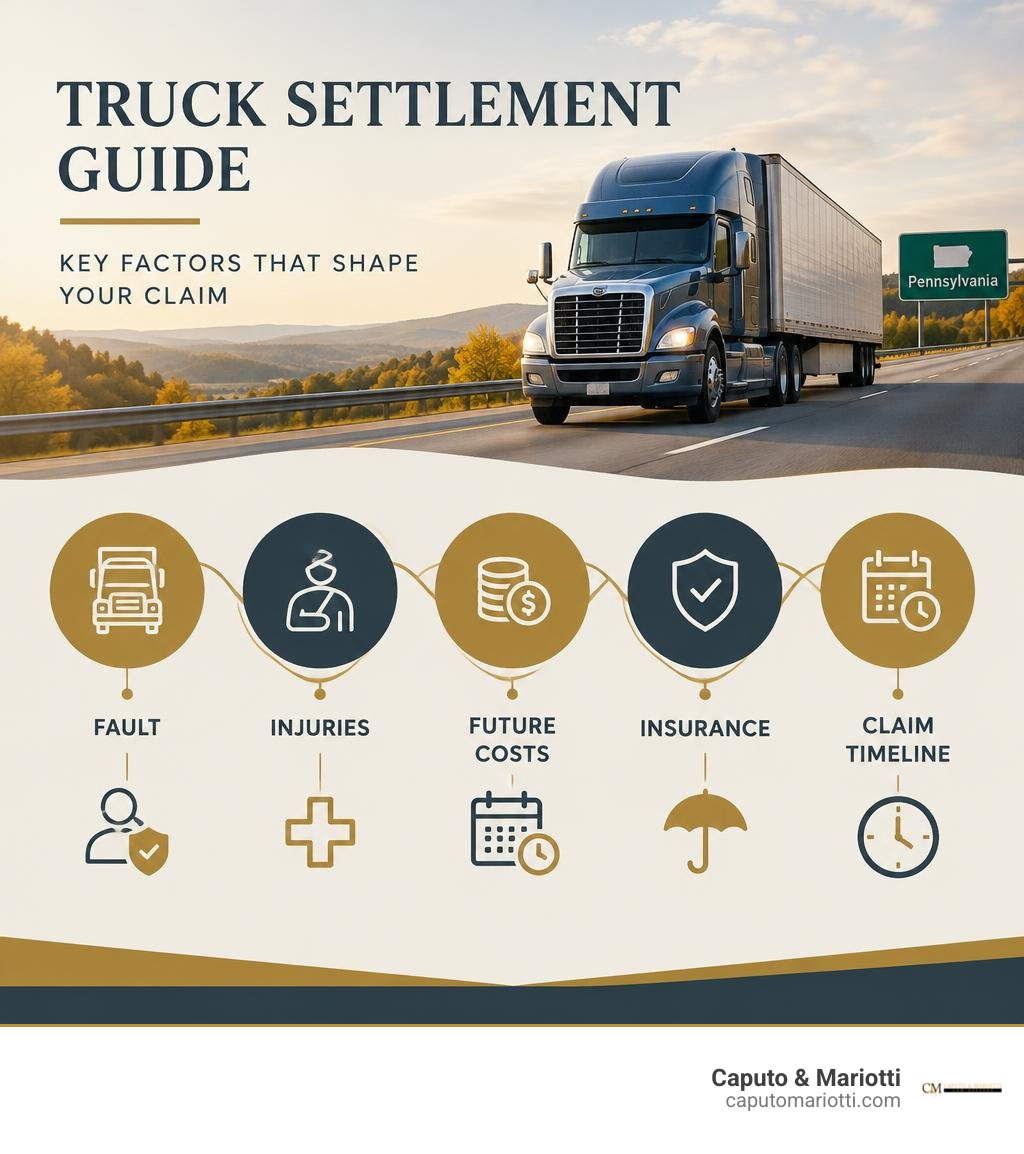
Key Factors Influencing a Truck Accident Settlement in Pennsylvania
Navigating a commercial motor vehicle crash claim differs sharply from handling a standard passenger car collision. Semi-trucks, tractor-trailers, vocational fleet vehicles, and dump trucks carry massive weight and kinetic force, resulting in catastrophic property damage and life-altering physical trauma. Because commercial operators must comply with strict state and federal safety guidelines, liability calculations require examining federal motor carrier standards, vehicle maintenance protocols, and layered corporate insurance policies.
To secure a fair payout, several core pillars must be established:
- Liability and Safety Violations: Proving that the driver or motor carrier violated rules established by the Federal Motor Carrier Safety Administration (FMCSA) or Title 75 of the Pennsylvania Consolidated Statutes.
- Commercial Policy Limits: Commercial trucks carry significantly higher liability coverage than passenger vehicles—often starting at $750,000 to $1,000,000 for general freight and reaching tens of millions in excess and umbrella coverage.
- Economic Losses: Concrete financial costs including emergency trauma care, hospital stays, surgical procedures, ongoing rehabilitation, specialized durable medical equipment, and proven loss of earning capacity.
- Non-Economic Damages: Pain, suffering, loss of life’s pleasures, disfigurement, and emotional trauma under Pennsylvania law.

Understanding how insurance companies calculate injury settlements is critical. Adjusters and corporate defense lawyers examine every line of evidence to discount liability or downplay the victim’s ongoing suffering. Knowing the full range of recovering personal injury damages under Pennsylvania law ensures that no future cost is omitted during negotiation.
| Injury Severity / Liability Profile | Primary Economic Factors | Insurance & Liability Dynamics | Potential Value Spectrum |
|---|---|---|---|
| Catastrophic (Paralysis, Severe TBI, Amputation) | Lifetime round-the-clock nursing care, home modifications, total future wage loss | Multi-layered commercial carrier policies, third-party maintenance liability | Multi-Million ($2,000,000 to $25,000,000+) |
| Severe (Multiple Fractures, Spinal Fusion, Joint Reconstruction) | Multiple major surgeries, extended lost wages, physical therapy | Single or excess commercial liability policy limits | High-Six to Low-Seven Figures ($500,000 to $2,000,000) |
| Moderate (Soft Tissue, Non-Surgical Disc Bulges, Mild Concussion) | Short-term physical therapy, diagnostic imaging, brief time off work | Primary commercial auto policy | Five to Mid-Six Figures ($50,000 to $350,000) |
How Severe Injuries Dictate a Truck Accident Settlement in Pennsylvania
The single most influential component in any high-value truck wreck recovery is medical damages. Catastrophic injuries—such as traumatic brain injury (TBI), spinal cord damage resulting in paraplegia or quadriplegia, internal organ crushing, and complex orthopedic fractures—demand specialized life care plans.
A comprehensive life care plan projects the cost of medical care over decades. It includes:
- Future surgical revisions and specialized medical equipment replacement.
- In-home health aides or skilled nursing assistance.
- Accessible vehicle adaptations and residential renovations.
- Lifetime loss of earning power and occupational benefits.
Recognizing and identifying catastrophic truck accident injuries early allows us to bring in clinical and financial experts who translate medical prognoses into hard financial figures that insurers cannot dismiss.
Multiple Liable Parties and Commercial Fleet Insurance Limits
Unlike typical car accidents involving two private drivers, commercial truck wrecks frequently feature multiple corporate entities sharing fault. These liable parties often include:
- The Truck Driver: For reckless driving, hours-of-service violations, distraction, or driving under the influence.
- The Motor Carrier / Trucking Company: For negligent hiring, inadequate driver qualification vetting, failure to enforce drug testing, or demanding impossible delivery schedules.
- Third-Party Maintenance Contractors: For faulty repairs, skipped mandatory inspections, or releasing unroadworthy vehicles back onto Pennsylvania roads.
- Freight Brokers and Shippers: For improper cargo securement or overloading vehicles beyond safe operating weights.
When multiple defendants are involved, their individual liability and excess commercial insurance policies can be triggered simultaneously. Understanding the legal steps to sue a trucking company in Pennsylvania enables injured individuals to establish vicarious liability, uncover hidden policies, and hold all culpable entities accountable.
Landmark Case Studies: What Pennsylvania Truck Accident Payouts Reveal
Real-world legal outcomes illustrate how systemic commercial maintenance failures, federal safety violations, and aggressive litigation strategies shape major truck accident recoveries across Pennsylvania courts.
The $26.55 Million Case: Fleet Maintenance Negligence and Bald Tires
One of the most consequential personal injury cases in Pennsylvania legal history centered on severe fleet maintenance neglect. Former landscaper David Williams suffered permanent paralysis (quadriplegia) when the company pickup truck rolled over due to a catastrophic tire failure.
The investigation revealed shocking maintenance oversights:
- A Known Dangerous Defect: The truck was operated on a completely bald tire.
- Ignored Maintenance Warnings: An outside maintenance technician had specifically flagged the tire as dangerous and noted that it needed immediate replacement.
- Failure to Remove from Service: The vehicle was returned to regular duty rather than being placed out of service, exposing workers and the public to extreme danger.
The lawsuit named TruGreen and ServiceMaster (the corporate fleet owners), Dickinson Fleet Management (the maintenance contractor), and Brooks Auto Repair. The defendants agreed to pay a record-breaking $26.55 million settlement in Philadelphia County:
- $16.75 million paid by TruGreen and ServiceMaster
- $9.5 million paid by Dickinson Fleet Management
- $300,000 paid by Brooks Auto Repair
As detailed in industry reporting on fleet tire maintenance failure reporting and this record commercial truck accident recovery, this landmark outcome demonstrated that Pennsylvania courts and juries will hold commercial fleet operators and contracted maintenance providers liable when vehicle safety inspections are disregarded.
Overcoming Comparative Negligence in a Truck Accident Settlement Pennsylvania Claim
Insurance carriers frequently attempt to lower payout obligations by raising comparative negligence defenses under 42 Pa.C.S. § 7102. Under Pennsylvania’s modified comparative negligence standard, an injured plaintiff can recover damages as long as their share of fault is 50% or less, though their total recovery is reduced by their percentage of fault.
A prime example of defeating these defenses occurred in a case involving a 42-year-old motorist rear-ended by a commercial dump truck hauling nearly 72,000 pounds of stone. The defense argued that the plaintiff changed lanes abruptly, claiming comparative fault.
Plaintiff counsel dismantled this defense by combining hard physical evidence and federal regulatory scrutiny:
- Excessive Speed: Accident reconstruction proved the heavily loaded dump truck was traveling 65 mph in a 45 mph zone on Route 422.
- Prohibited Narcotics Violation: Discovery uncovered that the commercial driver was operating the vehicle while taking oxycodone, violating FMCSA medical fitness regulations.
- Employer Negligence: The motor carrier failed to vet and train the driver properly.
This meticulous investigation yielded a $1.75 million settlement for the injured driver’s head, neck, back, and knee injuries, proving how thorough legal preparation and accident reconstruction are crucial for maximizing financial recovery in complex truck claims.
The Commercial Truck Settlement Process: Timeline from Crash to Resolution
Commercial truck litigation moves through structured phases. Because corporate insurers deploy rapid-response defense teams to the accident scene within hours, injured victims must act promptly to preserve crucial telemetry and mechanical evidence.
Phase 1: Rapid Evidence Preservation and Federal Regulatory Violations
The earliest stage of a truck accident claim focuses on securing physical, electronic, and corporate documentation before it is altered, overwritten, or destroyed:
- Formal Spoliation Letters: Issuing immediate legal demands requiring the motor carrier to preserve electronic logging device (ELD) records, engine control module (ECM) black box telemetry, dashcam footage, and GPS data.
- Driver Qualification Files (DQF): Scrutinizing the driver’s commercial driver’s license (CDL) status, medical examiner certificates, background checks, and prior moving violations.
- Hours-of-Service (HOS) Logs: Analyzing driver logs for falsifications, fatigue, and driving-time cap violations.
- Post-Crash Drug and Alcohol Testing: Verifying compliance with mandatory federal testing protocols following an injury-producing wreck.
- Vehicle Inspection and Maintenance Records: Reviewing Driver Vehicle Inspection Reports (DVIRs), brake maintenance history, and tire tread depth logs.
For individuals injured while on the job—such as commercial drivers, utility technicians, or delivery workers—navigating a third-party negligence lawsuit alongside a workers’ compensation claim requires specialized guidance. In Pennsylvania, the workers’ compensation system is a no-fault framework designed to provide wage loss benefits and coverage for reasonable medical care.
Injured workers must formally report the injury to their employer within 21 days (and no later than 120 days) under the Pennsylvania Workers’ Compensation Act. During the first 90 days of treatment, employees may be required to see an employer-designated panel physician if a valid panel list was posted and acknowledged in writing.
Evidence gathering—including securing witness statements, gathering complete hospital records, documenting physical restrictions, and filing a formal Claim Petition (Form LIBC-362) if benefits are denied—is essential. If an employer or insurer disputes the claim, legal appeals proceed before a Workers’ Compensation Judge (WCJ), followed by potential reviews before the Workers’ Compensation Appeal Board (WCAB) and the Commonwealth Court of Pennsylvania. Working with a dedicated workers’ compensation lawyer ensures your immediate wage benefits are protected while we pursue separate third-party claims against negligent corporate trucking fleets.
Phase 2: Formal Negotiations, Mediation, and Courtroom Preparation
Once the injured person reaches Maximum Medical Improvement (MMI)—the point where long-term medical stability and permanent limitations are clear—we prepare a comprehensive settlement demand package. This package combines medical narrative reports, vocational assessments, economic damage calculations, and regulatory violation analyses.
If the commercial insurer refuses to present a full and fair offer, the claim advances into formal litigation:
- Filing the Complaint: Initiating the lawsuit in the appropriate Court of Common Pleas (such as Lackawanna or Luzerne County) or the U.S. District Court for the Middle District of Pennsylvania.
- Discovery & Depositions: Questioning corporate safety directors, fleet mechanics, safety managers, and the driver under oath.
- Alternative Dispute Resolution (ADR): Presenting the case before an experienced neutral mediator or arbitrator to resolve contested issues.
- Trial Preparation: Structuring exhibit lists, video depositions, and medical illustrations for a jury verdict if the defense relies on lowball settlement tactics.
Carefully weighing a personal injury settlement versus trial in Pennsylvania and evaluating early settlement offers ensures that you do not leave vital financial compensation on the table. This is where the importance of skilled truck accident representation provides leverage against corporate defense teams.
Frequently Asked Questions About Truck Accident Settlements in Pennsylvania
What is the average truck accident settlement in Pennsylvania?
There is no mathematical “average” payout because every truck crash involves unique circumstances, injuries, and insurance policies. While minor soft-tissue cases may resolve in five-figure amounts, cases involving spinal cord trauma, severe TBI, or wrongful death frequently reach multi-million-dollar outcomes. Reviewing general average personal injury payout guidelines in Pennsylvania helps clarify how non-economic damage multipliers and economic documentation dictate final recovery figures.
How long does it take to settle a Pennsylvania commercial truck accident claim?
A standard truck crash claim typically takes anywhere from 6 months to over 2 years to resolve. Straightforward claims with undisputed liability and completed medical treatment settle faster. In contrast, complex cases with catastrophic injuries, multiple liable defendants, or corporate denial of fault require formal litigation, expert depositions, and detailed discovery before reaching a resolution.
Under Pennsylvania’s statute of limitations (42 Pa.C.S. § 5524), an injured party generally has two years from the date of the wreck to file a formal lawsuit. Missing this hard deadline forfeits your right to compensation.
Who can be held legally responsible for a truck accident in Pennsylvania?
Depending on the facts uncovered during the investigation, liability may fall upon:
- The commercial truck driver (reckless driving, speeding, fatigue, impairment).
- The motor carrier or trucking fleet company (negligent hiring, maintenance failures, safety violations).
- Third-party maintenance contractors (negligent mechanical work, overlooked inspection defects).
- Freight shipping and loading companies (improper weight distribution, shifting freight).
- Commercial vehicle and parts manufacturers (defective brake assemblies, tire blowouts, steering malfunctions).
Conclusion: Securing Full Justice After a Serious Pennsylvania Truck Crash
A commercial truck accident can alter your life in an instant, creating physical, emotional, and financial burdens. Large motor carriers and their multi-layered insurance companies have substantial resources to defend claims and minimize payouts. To stand on equal ground, you need a legal team with the knowledge, resources, and trial readiness to hold negligent corporations accountable.
At Caputo & Mariotti, we bring more than 55 years of combined legal experience to personal injury, medical malpractice, and complex injury lawsuits across Northeastern Pennsylvania—including Scranton, Wilkes-Barre, Hazleton, Pittston, Dickson City, Moosic, and throughout Lackawanna and Luzerne Counties. Our dedicated team is committed to uncovering every safety violation, calculating your full lifetime damages, and fighting for the justice you deserve.
If you or a family member was injured in a collision with a commercial vehicle, speak with an experienced Scranton truck accident lawyer today. Contact Caputo & Mariotti to request a free case consultation and learn how we can protect your rights and fight for maximum financial recovery.
