

The dedicated legal team of Caputo & Mariotti
The Ultimate Guide to Average Personal Injury Settlement Pennsylvania
October 29, 2026
What Is the Average Personal Injury Settlement in Pennsylvania?
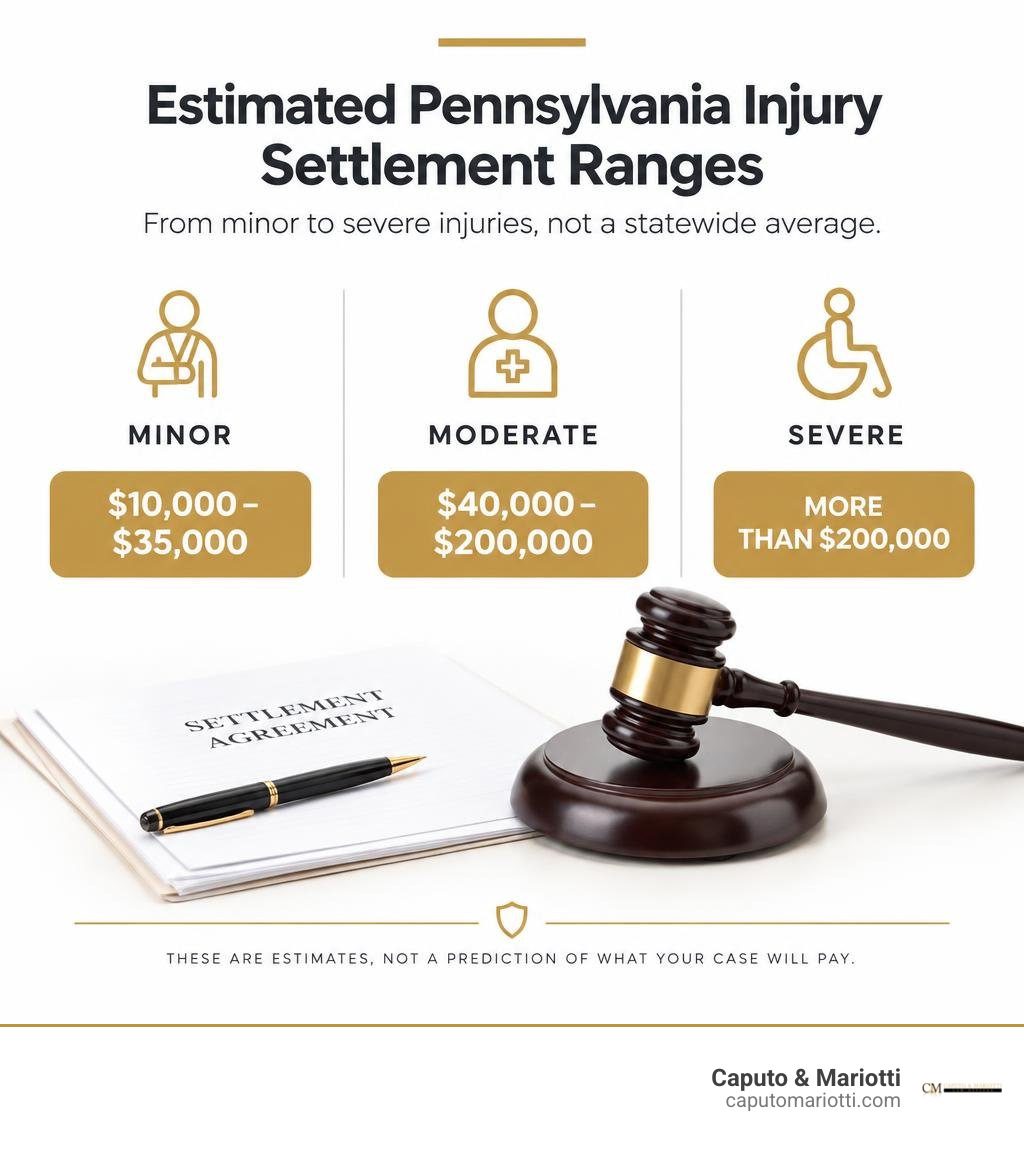
There is no reliable, published statewide average for Pennsylvania personal injury settlements. As a rough guide, minor injuries may settle for $10,000 to $35,000, while moderate injuries may settle for $40,000 to $200,000. Severe injuries can bring more. These are estimates, not a prediction of what your case will pay.
A single average can mislead because a few very large cases pull it up. Your injury, medical records, share of fault, and available insurance matter more. In a car crash claim, your choice of limited tort or full tort can also change what you may recover.
A useful case review looks beyond a headline number and focuses on the proof available at each stage of the claim. Medical documentation, the effect of the injury on work and daily activities, and the policy limits involved can all influence whether a settlement discussion reflects the full circumstances of the case.
Each claim deserves an individual review.
I’m Chris Caputo, a Pennsylvania personal injury attorney who has tried, litigated, and settled injury claims for decades. I help people asking what the average personal injury settlement in Pennsylvania is move past broad numbers and understand the facts that shape their own claim.
Helpful reading on Pennsylvania personal injury settlements:
- how insurance companies calculate injury settlements
- how to document injuries after an accident pennsylvania
- personal injury lawyer contingency fee explained
Pennsylvania Personal Injury Settlement Benchmarks
When injured individuals review statistical data across the Commonwealth, they often encounter two vastly different figures: the arithmetic mean (average) and the median. In Pennsylvania civil court actions, the average jury verdict reaches approximately $903,705.00. However, the median compensatory award sits at a much lower $45,000.00.
This statistical divide exists because a small fraction of catastrophic cases involving life-altering trauma, extensive medical malpractice, or wrongful death yield multimillion-dollar awards. These high-value outliers pull the mathematical average upward. Looking strictly at an average provides an inflated view of what standard claims yield. The median figure—representing the exact midpoint where half of all recoveries are higher and half are lower—serves as a much more realistic benchmark for evaluating an injury claim.
For that reason, a verdict statistic and a settlement estimate should not be treated as interchangeable. A verdict follows a court proceeding and may include facts that are not present in a typical negotiated claim. A settlement is usually shaped by the available evidence, the parties’ assessment of fault, the treatment history, and the insurance coverage available to pay a claim.
The practical value of a benchmark is to frame questions, not to promise a result. A person comparing cases should ask whether the injuries, treatment, recovery period, and liability evidence are genuinely similar. Even two claims involving the same type of collision can differ substantially when medical records, prior conditions, missed work, or available coverage are different.
A careful comparison also separates the value of a claim from the amount a claimant ultimately receives. Medical expenses, lost income, and other documented losses may be evaluated alongside non-economic harm, but the evidence supporting each category matters. Negotiations can also change as treatment develops or as additional records become available. Rather than relying on a single number, an informed assessment considers the complete record and the practical limits that affect resolution. It can be helpful to identify unanswered questions early, such as whether fault is disputed, whether treatment is ongoing, or whether available insurance coverage may limit payment. Those issues often matter more than a broad statewide comparison. They should be addressed through the records and facts specific to the case.
A comprehensive look at civil outcomes reveals that settlement distribution generally falls into clear segments:
- Under $10,000 (15%): Typically involves minor soft tissue strains, minimal emergency room evaluations, or swift recoveries without lasting functional deficits.
- $10,000 to $75,000 (50%): Represents the core majority of resolved claims, covering documented sprains, minor fractures, and non-surgical disc issues requiring physical therapy.
- $75,000 to $200,000 (20%): Encompasses moderate-to-severe injuries requiring invasive interventions, such as surgical repair, injections, or extended work absences.
- Over $200,000 (10%): Involves substantial trauma, traumatic brain injuries, multiple surgeries, or permanent disability.
- Multimillion-Dollar Settlements (5%): Catastrophic cases causing permanent dependence, paralysis, or severe institutional liability.
To build an accurate assessment, one must evaluate both economic losses (medical bills, future treatment costs, lost income) and non-economic damages (pain, suffering, loss of life enjoyment). A complete evaluation requires understanding compensation in personal injury cases and how these damage categories function together under state law.
What Is the Average Personal Injury Settlement in Pennsylvania for Full Tort vs. Limited Tort Claims?
For motor vehicle collisions across Pennsylvania, your automobile insurance policy election serves as a primary legal factor determining your financial recovery. Under the Pennsylvania Motor Vehicle Financial Responsibility Law (MVFRL), drivers choose between Full Tort and Limited Tort coverage.
- Full Tort Coverage: Preserves your unrestricted legal right to pursue compensation for all economic losses as well as non-economic damages—commonly known as pain and suffering—regardless of how minor or severe your physical injuries are.
- Limited Tort Coverage: Reduces annual insurance premiums by waiving your right to pursue non-economic damages for pain and suffering unless your physical injuries meet the statutory threshold of a “serious impairment of body function.”
If you hold limited tort coverage and sustain soft-tissue injuries that heal within weeks, your recovery is confined strictly to out-of-pocket medical bills and unreimbursed wage losses. Because non-economic damages often constitute more than half of a bodily injury settlement, electing limited tort without meeting an exception substantially lowers your payout potential.
| Tort Election Status | Recoverable Damages | Non-Economic (Pain & Suffering) Threshold | Typical Settlement Impact |
|---|---|---|---|
| Full Tort | All medical bills, past/future lost wages, physical pain, emotional distress, loss of life enjoyment. | None required; open for all documented injuries. | Full baseline value; represented full-tort claimants with documented injuries frequently settle near $80,000. |
| Limited Tort | Out-of-pocket medical expenses, property loss, and verified economic wage loss. | Must prove “serious impairment of body function” or meet statutory exceptions. | Often reduces total claim recovery value by 50% or more if threshold is unmet. |
Statutory exceptions can pierce limited tort, restoring full-tort rights even if your policy documents state limited tort. These exceptions include being struck as a pedestrian, riding in a commercial vehicle, being hit by an out-of-state registered vehicle, or being hit by a driver convicted of driving under the influence (DUI).
Evaluating the Average Personal Injury Settlement in Pennsylvania by Severity Band
Because legal claims depend directly on diagnostic proof, evaluating cases by injury severity bands provides clear insights into value ranges.
| Injury Category | Diagnostic Examples | Common Treatment Paths | Typical Settlement Range |
|---|---|---|---|
| Minor / Soft Tissue | Cervical sprains, whiplash, contusions, minor strains | Urgent care, chiropractic visits, physical therapy (4–8 weeks) | $10,000 – $35,000 |
| Moderate Injuries | Simple bone fractures, non-surgical disc herniations, torn meniscus | Immobilization, casting, targeted steroid injections, extended physical therapy | $40,000 – $200,000 |
| Severe Injuries | Complex fractures requiring hardware, spinal fusion, moderate Traumatic Brain Injury (TBI) | Open reduction internal fixation (ORIF), neurosurgery, lengthy vocational rehabilitation | $200,000 – $2,000,000+ |
| Catastrophic Trauma | Severe spinal cord damage (paralysis), permanent cognitive impairment, amputation | Inpatient hospitalization, lifetime daily care, assistive home modifications | Multimillion-Dollar Ranges |
Key Pennsylvania Legal Rules That Impact Your Settlement Payout
State statutes and jurisdictional rules directly influence how much money an injured party actually recovers from an insurance carrier in Pennsylvania. A thorough evaluation begins by understanding how insurance companies calculate injury settlements, as insurers rely heavily on computer software algorithms and statutory liability defenses to reduce payout offers.
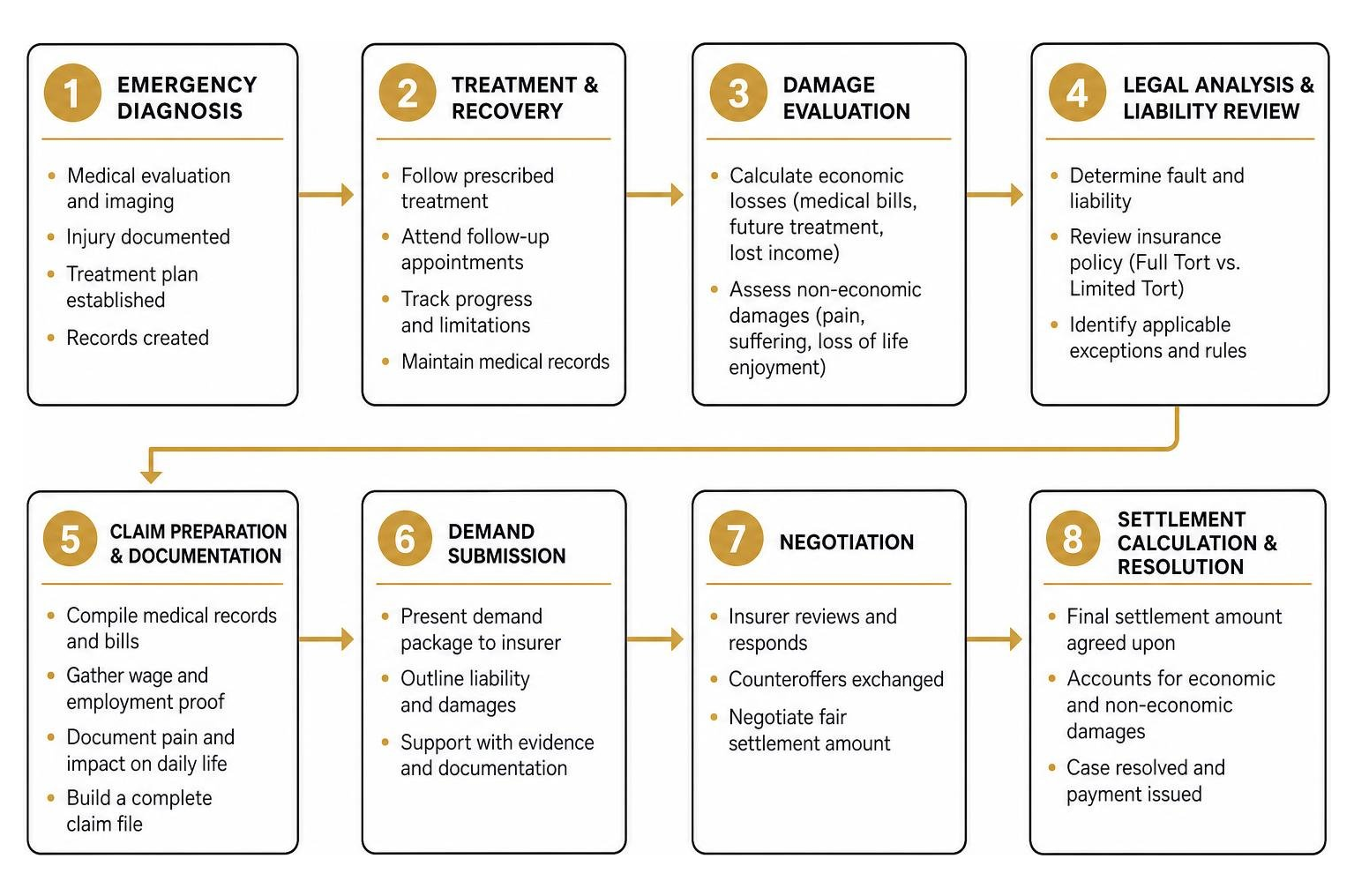
Insurance carriers may review the same categories of information throughout a claim, including medical records, bills, wage-loss documentation, accident reports, and evidence about fault. Clear, consistent records help show how an injury affected the claimant and why the requested compensation is tied to documented losses. The legal rules that apply to the claim remain important because they can affect both the available recovery and the timing of key decisions.
Claimants should also keep copies of correspondence and avoid assuming that an insurer’s first request captures every relevant detail. When information is incomplete, it can be harder to explain the connection between the incident, treatment, and financial losses. A complete file supports a more informed discussion of the claim. It also gives the claimant and attorney a clearer basis for responding to questions during negotiations or litigation.
If your injury occurred on the job, your recovery pathway may involve administrative workers’ compensation remedies alongside third-party claims. A qualified workers’ compensation lawyer helps claimants navigate Pennsylvania’s no-fault system. This statutory process requires reporting the incident within 21 to 120 days under Section 311 of the Pennsylvania Workers’ Compensation Act, obtaining medical treatment with designated panel physicians during the initial 90-day window, documenting incident reports, gathering eyewitness accounts and medical records, filing formal Claim Petitions before the Bureau of Workers’ Compensation, and managing legal appeals if benefits face denials or wage miscalculations.
Comparative Negligence and the 51% Fault Bar
Under Pennsylvania’s modified comparative fault rule (42 Pa.C.S. § 7102), an injured plaintiff’s financial recovery depends on their level of responsibility for the underlying incident:
- Recovery Reduction: If you are allocated a percentage of fault that is 50% or less, your financial compensation is reduced in direct proportion to that percentage. For example, if your total damages equal $100,000 but you are determined to be 20% responsible, your recoverable settlement becomes $80,000.
- Complete Recovery Bar: If you are found to be 51% or more at fault for the accident, you are legally barred from recovering any damages from the other party.
In multi-defendant claims, Pennsylvania’s Fair Share Act dictates that a defendant is generally only responsible for their allocated percentage of liability, unless a specific defendant is found 60% or more liable, in which case they may be held jointly and severally responsible for the full non-economic award.
Venue and County Differences: Philadelphia vs. Rural PA
The physical location where a civil action is filed—known as venue—significantly alters insurance carrier settlement evaluations. Juries in urban jurisdictions like Philadelphia County and Allegheny County historically award higher compensatory damages compared to conservative, rural counties.
For instance, represented full-tort motor vehicle accident claimants with documented physical trauma in Philadelphia County frequently settle around $105,000, compared to an average of roughly $48,000 for similar injuries resolved in rural jurisdictions. In Philadelphia County, civil jury verdicts regularly feature high-value outcomes, with roughly 11.5% of verdicts reaching $1 million or more. Insurance adjusters account for these jury tendencies during early settlement negotiations.
Proven Steps to Maximize Your Pennsylvania Injury Settlement
Securing a fair settlement requires disciplined legal strategy and detailed evidence preservation. You can explore proven strategies through our guide on personal injury and ways to increase compensation.
- Seek Prompt Medical Care: Visit an emergency department, urgent care center, or primary physician immediately following an incident to establish a clear causal link between the accident and your symptoms.
- Follow Prescribed Treatment Protocols: Gaps in physical therapy or missed doctor appointments are quickly used by insurance adjusters to argue that your physical recovery was complete.
- Reach Maximum Medical Improvement (MMI): Never accept a quick settlement offer before your treating physicians determine that your condition has stabilized. Settling before reaching MMI risks leaving future surgical costs or ongoing medical care unpaid.
- Preserve Detailed Evidence: Maintain photographs of vehicle damage, physical injuries, hazardous property conditions, prescription receipts, and written notes tracking daily physical limitations.
Keeping records organized can make it easier to explain the course of treatment and the effect of an injury over time. Save appointment summaries, bills, receipts, work-related correspondence, and photographs in one place. A simple timeline of symptoms, treatment, missed work, and important communications can also help identify gaps that may need clarification before a claim is evaluated. These materials do not determine a result by themselves, but they can provide useful support for the facts of the claim.
It is also important to keep communication with health care providers and insurers accurate and consistent. Describe symptoms and limitations honestly, attend scheduled appointments when possible, and retain copies of written updates. If a provider changes a treatment plan or work restriction, add that information to the claim file so the record reflects the current condition. This helps prevent avoidable confusion when questions arise later.
Successfully resolving a case involves mastering the settlement process through formal demand packages, evidentiary presentations, and calculated negotiation sessions.
Resolving Liens and Understanding Tax Implications
Maximizing your take-home payout requires handling statutory liens. When health insurance plans, Medicare, Medicaid, or workers’ compensation carriers cover accident-related medical bills, they typically hold a legal subrogation right to be reimbursed from your final gross settlement.
Failing to account for these obligations can lead to severe financial penalties. Learning how to prevent liens from ruining your settlement through aggressive post-settlement lien negotiation is essential for protecting your net recovery.
From a tax perspective, compensatory damages received for physical personal injuries or physical sickness are non-taxable at both the federal level (Internal Revenue Code Section 104(a)(2)) and under the Pennsylvania Personal Income Tax (PIT) rules. This non-taxable status applies to funds paid for medical bills, physical pain, and emotional distress stemming directly from physical trauma. However, interest accrued on judgments or punitive damages awarded to punish extreme wrongdoing remain fully taxable.
Pennsylvania Statutes of Limitations and Government Notice Deadlines
Under Pennsylvania Consolidated Statutes Title 42 Section 5524, the statute of limitations for filing a personal injury lawsuit is generally two years from the date the injury occurred. Missing this filing deadline permanently extinguishes your legal right to seek compensation in court.
Special rules apply when pursuing claims against public entities. Under 42 Pa.C.S. § 5522, if your injury involves a municipal entity, school district, public transit authority, or Commonwealth agency, you must serve formal written notice within six months of the incident. Furthermore, statutory damages against government bodies are capped at $250,000 for Commonwealth agency claims and $500,000 for local government entities. Following the appropriate steps to file a personal injury claim in Pennsylvania ensures these strict procedural rules are met.
Frequently Asked Questions About Pennsylvania Personal Injury Settlements
How long does it take to settle a personal injury case in Pennsylvania?
Most personal injury claims in Pennsylvania resolve within 6 to 18 months. Straightforward claims with undisputed liability and brief medical treatments often settle within 3 to 9 months once treatment concludes. Conversely, complex claims involving disputed fault, catastrophic injuries, or formal litigation can require 1 to 3 years to reach a trial verdict or final resolution.
Are personal injury settlements taxable under Pennsylvania law?
No, standard compensatory settlements covering physical injuries, related medical expenses, and pain and suffering are not taxable under Pennsylvania state law or federal income tax rules. Only specific line items, such as punitive damages or pre-judgment interest, are subject to standard income taxation.
Can I sue for pain and suffering with limited tort insurance in Pennsylvania?
Yes, but only if you meet specific legal criteria. Under limited tort, you can pursue compensation for pain and suffering if your medical records show you sustained a “serious impairment of body function”—typically involving permanent limitations, significant scarring, or life-altering structural damage—or if your accident qualifies under a statutory exception, such as being struck by an out-of-state vehicle or a drunk driver.
Whether an exception applies depends on the policy language and the facts of the collision. Reviewing the insurance declarations page, accident details, and medical documentation can help clarify whether a limited-tort restriction may affect the claim.
Because these issues can turn on specific facts, it is useful to seek legal advice before assuming that limited tort prevents a claim for non-economic damages.
Conclusion: Securing Fair Compensation for Your Pennsylvania Claim
Navigating insurance settlements, statutory thresholds, and comparative fault rules requires focused legal advocacy. With more than 55 years of combined legal experience serving clients throughout Northeastern Pennsylvania—including Scranton, Wilkes-Barre, Lackawanna County, and Luzerne County—Caputo & Mariotti works to secure the maximum compensation our clients deserve.
A focused review of the facts, records, and applicable deadlines can help a claimant make informed decisions about next steps.
Timely legal guidance may protect options while the claim develops.
If you or a loved one has suffered an injury due to someone else’s negligence, contact our team for dedicated personal injury legal representation and schedule a free consultation to review your legal options today.
