

The dedicated legal team of Caputo & Mariotti
Navigating PA Crash Protocol: Practical Steps for Drivers
November 23, 2026
Essential Checklist: What to Do After a Car Accident in Pennsylvania
If you have just been in a crash, the immediate steps are straightforward: check yourself and your passengers for injuries and call 911 if anyone is hurt, move vehicles out of traffic if they are drivable and turn on your hazard lights if they are not, exchange driver and insurance information with the other parties involved, photograph the vehicles, damage, and surrounding scene, and collect contact information from any witnesses. Once everyone is safe and the scene is documented, seek a medical evaluation even if you feel fine, since some injuries take time to appear.
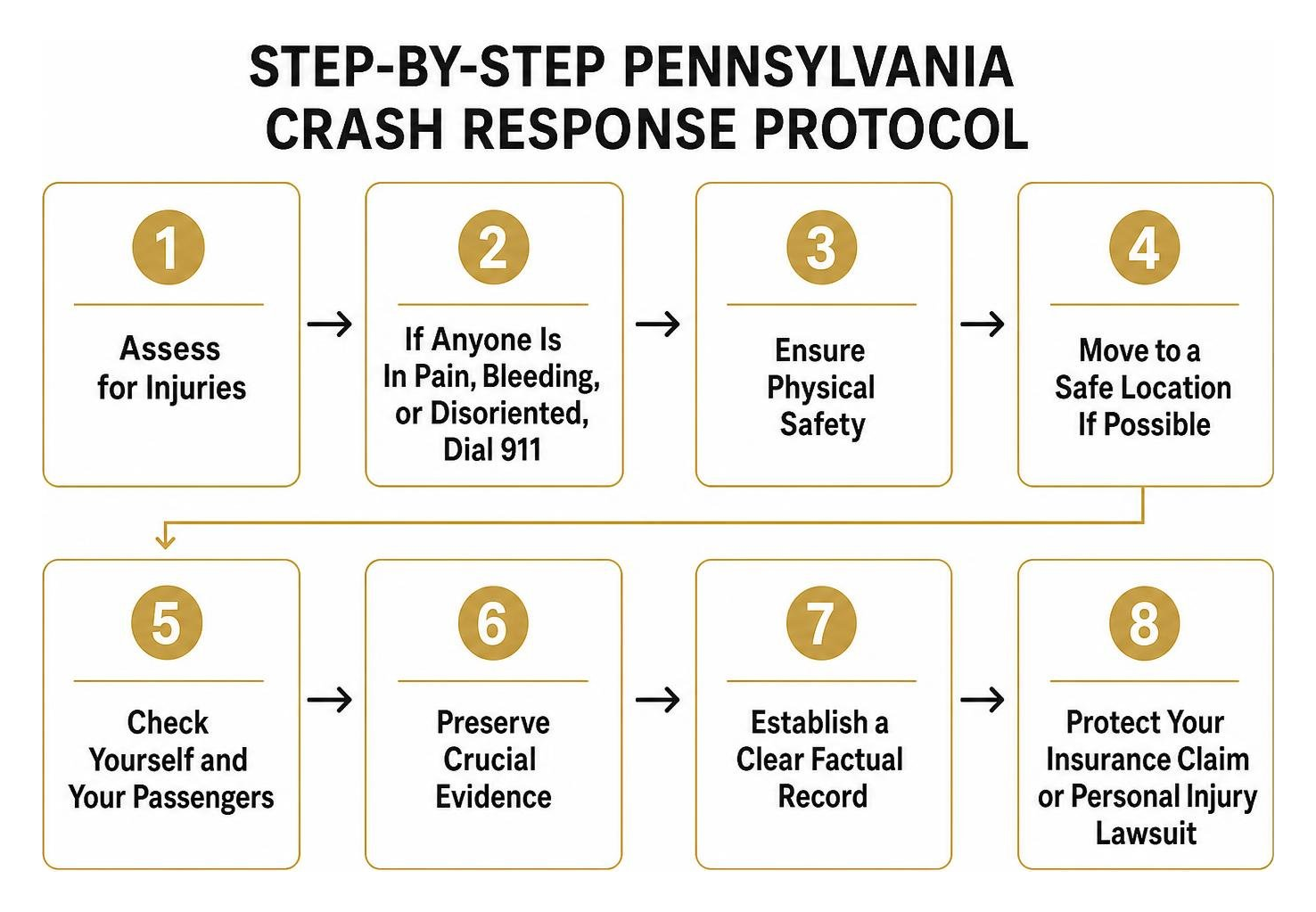
Adhering to structured, step-by-step accident procedures helps protect your physical well-being, preserves crucial evidence, and establishes a clear factual record for any future insurance claim or personal injury lawsuit. Knowing what to do after a car accident in Pennsylvania also means understanding the state’s specific reporting and insurance rules before you ever need them.
Immediate Scene Safety and Emergency Response
Your top priority following any collision in Northeastern Pennsylvania—whether on Interstate 81 through Moosic or a local road in Lackawanna County—is ensuring physical safety.
- Assess for Injuries: Check yourself and your passengers for signs of trauma. If anyone is in pain, bleeding, or disoriented, dial 911 immediately.
- Secure the Vehicles: If the vehicles remain drivable and operate safely, move them to the shoulder or a nearby safe area out of active traffic. If a vehicle is disabled, turn on your hazard lights right away to alert oncoming drivers.
- Turn Off Ignitions: Shut off the engine to reduce the risk of fire from ruptured fuel lines or electrical shorts.
- Remain in a Safe Position: If you are stranded on a busy highway, remain inside your vehicle with your seatbelt fastened until emergency personnel arrive, unless an immediate fire or hazard requires you to exit.
Critical Evidence Collection and Information Exchange
Thorough documentation compiled at the crash scene serves as the foundation of any subsequent claim. While waiting for law enforcement to arrive, gather necessary details from everyone involved:
- Driver & Vehicle Information: Exchange full names, residential addresses, phone numbers, driver’s license numbers, license plate numbers, vehicle makes and models, and auto insurance policy details.
- Scene Photography: Take wide and close-up photographs showing vehicle positioning, property damage, skid marks, broken glass, visual obstructions, road conditions, and prevailing weather.
- Witness Details: Collect contact information and take note of initial statements from neutral bystanders; gathering witness statements early often prevents key details from being forgotten.
- Injury Tracking: Take photographs of visible cuts, bruises, or swelling, and begin documenting post-accident injuries to create a clear timeline connecting your medical condition directly to the crash.
What to Do After a Car Accident in Pennsylvania on the Turnpike and Highways
High-speed corridors like the Pennsylvania Turnpike (I-476 / Northeast Extension) present heightened safety risks. With maximum speed limits reaching 70 MPH on rural segments, walking along active highway lanes is dangerous.
If an accident or mechanical breakdown occurs on the Turnpike:
- Contact Turnpike Dispatch: Dial *11 from your mobile phone or call 1-800-332-3880 to connect directly with the PA Turnpike Operations Center.
- Identify Your Location: Note the nearest green milepost marker and your direction of travel so emergency dispatchers and the GEICO Safety Patrol can pinpoint your location.
- Stay Inside the Vehicle: Keep your seatbelt fastened and wait for authorized service providers or the Pennsylvania State Police to secure the perimeter.
- Observe Weather Laws: Pennsylvania law requires headlight activation whenever windshield wipers are continuously operating due to rain, snow, or fog.
For further roadside emergency protocols, consult the PA Turnpike Safety Guide.
Pennsylvania Accident Reporting Laws and Crash Records
Navigating Pennsylvania’s vehicle code requires understanding when law enforcement must be summoned and how official public records are generated and retrieved.
When Pennsylvania Law Mandates Calling the Police
Under Title 75 of the Pennsylvania Consolidated Statutes (Vehicles), you are legally required to immediately notify the local police department or the Pennsylvania State Police if an accident results in any of the following:
- Injury to any driver, passenger, or pedestrian
- The death of any individual
- Vehicle damage severe enough that a vehicle cannot be driven safely from the scene under its own power
If municipal officers or state troopers arrive and investigate, they will file an official Commonwealth of Pennsylvania Police Crash Report (Form AA-500). If the crash meets reporting criteria but police do not investigate at the scene, drivers must file a Driver’s Accident Report (Form AA-600) with PennDOT within five days.
How to Request a Pennsylvania State Police Crash Report
An official police report contains objective findings regarding vehicle damage, points of impact, contributing driver actions, weather conditions, and citations issued.
To obtain a report generated by the Pennsylvania State Police:
- Observe the Waiting Period: Official crash reports generally become available 15 days after the incident date.
- Access the Crash Reports Unit: Requests can be completed via the Pennsylvania State Police online portal or submitted through the mail.
- Pay the Statutory Fee: The Commonwealth mandates a non-refundable statutory fee of $22 per report.
- Provide Required Identifiers: You must submit the incident number, crash date, county (such as Luzerne County or Lackawanna County), and the names of the involved drivers.
Key Pennsylvania Fault and Auto Insurance Regulations
Pennsylvania maintains distinct statutory rules governing motor vehicle insurance and civil liability.
Choice No-Fault Coverage: Limited Tort vs. Full Tort
Pennsylvania is a “choice no-fault” state. Regardless of who caused the collision, your own auto insurer pays initial medical bills through mandatory Personal Injury Protection (PIP) coverage (typically starting at a minimum of $5,000). However, your ability to recover non-economic damages—such as pain, suffering, and loss of life’s pleasures—depends on the tort option selected on your policy.
| Policy Option | Medical Expenses & Lost Wages | Non-Economic Damages (Pain & Suffering) | Legal Threshold Requirements |
|---|---|---|---|
| Limited Tort | Covered under PIP / Out-of-pocket economic losses recoverable from at-fault driver | Barred unless an exception applies | Must prove a “serious impairment of body function” or meet statutory exceptions |
| Full Tort | Covered under PIP / Out-of-pocket economic losses recoverable from at-fault driver | Fully recoverable from the at-fault driver | No injury threshold required; can pursue damages for any degree of pain and suffering |
Under limited tort, drivers can only seek non-economic damages if they sustain a catastrophic injury resulting in serious impairment of a body function, permanent disfigurement, or if an exception applies (e.g., the at-fault driver was driving under the influence or operated an out-of-state vehicle). Reviewing your policy is essential for understanding lawsuit eligibility.
Modified Comparative Negligence and the 51% Fault Bar
Pennsylvania operates under a modified comparative negligence standard (42 Pa.C.S. § 7102). Under these Pennsylvania comparative fault rules, an injured claimant can recover damages as long as their share of fault does not exceed 50%.
- The 51% Bar: If you are found to be 51% or more responsible for the collision, you are legally barred from recovering any financial compensation from other parties.
- Proportional Reduction: If you are 50% or less at fault, your total financial award is reduced by your exact percentage of liability. For instance, if your damages total $100,000 but you are determined to be 20% at fault, your net recovery is $80,000.
Pennsylvania Statute of Limitations for Injury Lawsuits
Under 42 Pa.C.S. § 5524, Pennsylvania enforces a strict two-year statute of limitations for personal injury and property damage lawsuits arising from motor vehicle collisions.
The statutory clock typically begins on the date of the collision. If a formal lawsuit is not filed in the appropriate court (such as the Court of Common Pleas in Lackawanna or Luzerne County) before this two-year deadline expires, your claim will be permanently barred. Familiarizing yourself with the statute of limitations for injury cases helps ensure all court deadlines are met.
Protecting Your Legal Claim and Maximizing Compensation

Taking calculated, deliberate steps following an accident helps preserve the integrity of your claim against aggressive insurance tactics.
What to Do After a Car Accident in Pennsylvania Regarding Insurance Adjusters
Insurance claims adjusters are trained professionals whose primary goal is minimizing payouts for their employers. When dealing with representatives from another driver’s insurance company:
- Decline Recorded Statements: You are not legally obligated to provide a recorded statement to the at-fault driver’s insurer without an attorney present. Adjusters often use open-ended questions to elicit answers that could undermine your claim.
- Avoid Signing Broad Medical Releases: Never execute blanket authorization forms that allow third-party insurers to comb through decades of irrelevant medical history.
- Reject Premature Settlement Offers: Early settlement checks offered within days of a crash rarely account for long-term medical care, future physical therapy, or sustained lost earning capacity.
For practical guidance on managing these interactions, review our recommendations for handling the at-fault driver’s insurance.
Identifying Delayed Symptoms and Calculating Available Damages
The adrenaline surge following a collision often masks pain. Serious conditions—including whiplash, soft tissue tears, herniated discs, and traumatic brain injuries (concussions)—frequently manifest hours or days after the impact. Seeking a comprehensive medical evaluation immediately creates the necessary diagnostic link between the crash and your physical condition.
Victims of negligent drivers in Pennsylvania may pursue various types of financial compensation:
- Economic Damages: Past and future medical bills, surgical expenses, prescription costs, rehabilitation, lost wages, and diminished earning capacity.
- Non-Economic Damages: Physical pain, mental anguish, physical impairment, and loss of life’s pleasures (subject to your Full Tort or Limited Tort policy parameters).
- Property Losses: Vehicle repair expenses, total-loss actual cash value, and damaged personal property.
Note for workplace crashes: If you were operating a vehicle within the scope of your employment when the collision occurred, Pennsylvania’s no-fault workers’ compensation system provides medical benefits and partial wage replacement regardless of driver fault. In such scenarios, you must notify your employer within statutory deadlines (21 to 120 days), obtain authorized medical treatment, compile detailed witness accounts and incident records, and adhere to formal claim petition filing procedures. Retaining a dedicated workers’ compensation lawyer ensures your workplace claims and third-party personal injury actions are handled effectively through any necessary appeals.
When to Retain an Experienced Injury Lawyer
Consulting an attorney is especially critical when:
- Fault is contested by the opposing motorist or their insurer
- Multiple vehicles or commercial trucks are involved
- Injuries are severe, disabling, or require surgical intervention
- The at-fault driver is uninsured or underinsured
Understanding the essential role of legal representation gives you access to accident reconstruction specialists, economic loss analysts, and trial advocates. If you were injured in Dickson City, Pittston, Wilkes-Barre, or Hazleton, consulting a trusted Scranton car accident lawyer levels the playing field against large corporate insurers.
Frequently Asked Questions About Pennsylvania Car Crashes
How long do I have to file an injury claim after a car accident in Pennsylvania?
In most cases, you have two years from the exact date of the collision to file a personal injury lawsuit in Pennsylvania civil court. Very limited statutory exceptions apply—such as cases involving injured minors, where the two-year clock begins on their 18th birthday. However, waiting to consult an attorney risks the loss of vital physical evidence and witness testimony.
Can I still recover damages if I was partially at fault for the accident?
Yes. Under Pennsylvania’s modified comparative negligence statute, you can recover financial compensation as long as your share of responsibility is 50% or less. Your total recovery will be reduced proportionately by your assigned percentage of fault. If a jury finds you 51% or more responsible, state law bars you from recovering any damages.
How do I get emergency roadside help on the PA Turnpike?
If you are involved in a collision or experience a breakdown on the Pennsylvania Turnpike, dial *11 from your mobile phone or call 1-800-332-3880. Provide dispatchers with the nearest green milepost marker, pull completely onto the shoulder if possible, activate your hazard lights, and remain inside your vehicle until authorized safety patrol or State Police personnel arrive.
Conclusion: Securing Your Recovery with Proven Legal Advocates
A serious motor vehicle collision can disrupt your physical health, financial stability, and emotional well-being. Navigating Pennsylvania’s choice no-fault insurance rules, modified comparative negligence standards, and strict statutory filing deadlines requires experienced legal guidance.
At Caputo & Mariotti, we bring more than 55 years of combined legal experience to every case we handle. We advocate for injured victims across Scranton, Wilkes-Barre, Hazleton, and all of Northeastern Pennsylvania. If you or a family member has been hurt in a motor vehicle collision, reach out to our team to schedule a free legal consultation and protect your right to full financial recovery.
