

The dedicated legal team of Caputo & Mariotti
How to Understand Contingency Fee Basics for Personal Injury Lawyers
October 2, 2026
Understand Your Personal Injury Contingency Fee Before You Sign
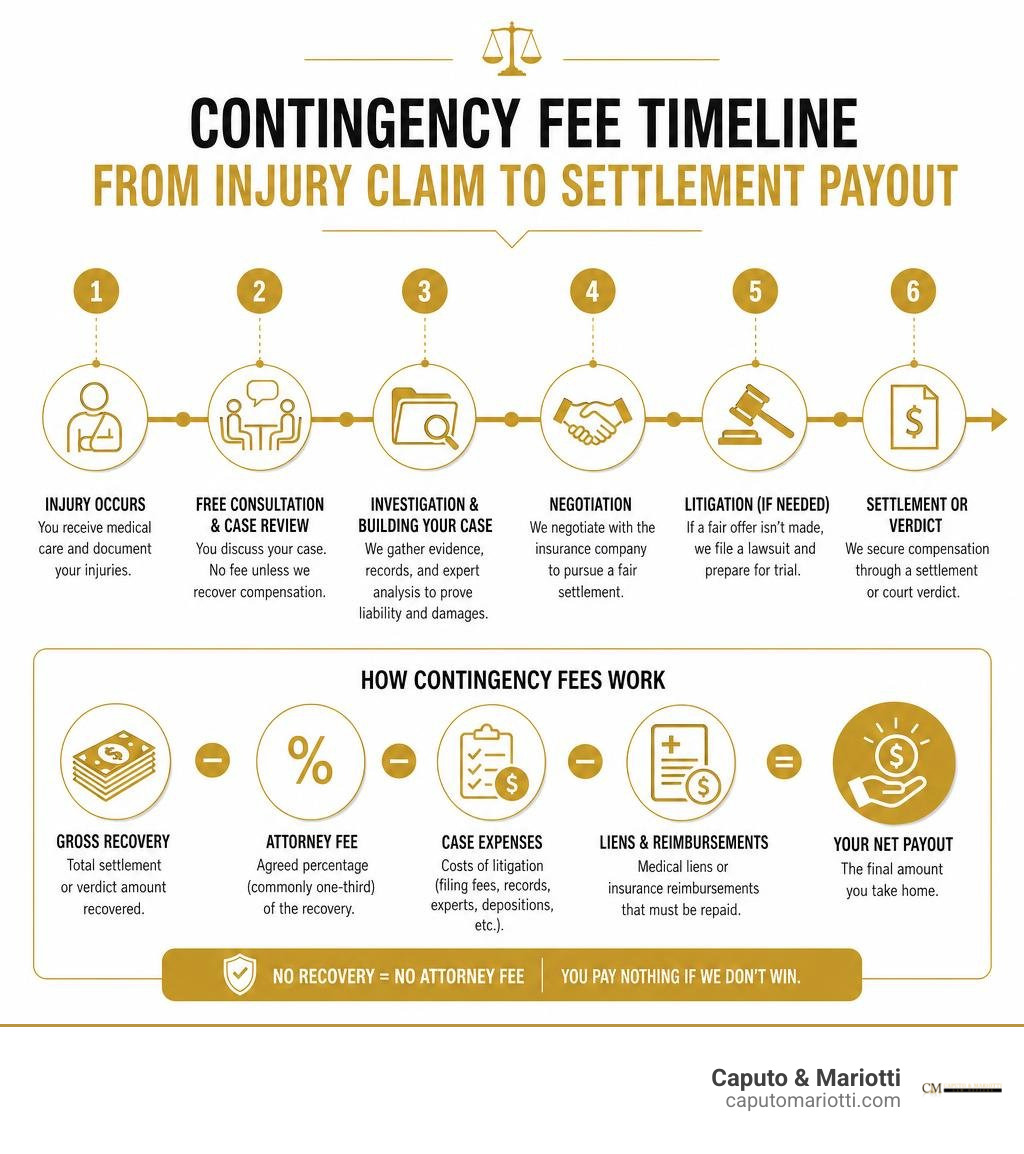
A contingency fee means your personal injury lawyer is paid a percentage of the money recovered through a settlement or verdict. You usually pay no attorney fee upfront, and no attorney fee if there is no recovery. Before signing, confirm the percentage, whether it rises if a lawsuit goes to trial, how case expenses are handled, and whether you could owe those expenses if the case does not succeed.
A one-third fee is common for many personal injury claims, while fees may rise to 40% or more when a case requires litigation, trial preparation, or an appeal. The lawyer’s fee is separate from costs such as filing fees, medical records, depositions, and expert witnesses. Medical liens or insurance reimbursement claims can also reduce the final amount you receive.
At Caputo & Mariotti, we believe the key is simple: review the written agreement and ask for a clear explanation of how every deduction affects your net recovery. A settlement figure is not necessarily the amount of the final check.
I am Chris Caputo, a Pennsylvania personal injury attorney who has represented seriously injured people and families since 2007 after years of courtroom and complex litigation experience. In this guide to a personal injury lawyer contingency fee explained, I will walk through the practical terms and calculations you should understand before hiring counsel.
Personal Injury Lawyer Contingency Fee Explained: How the Payment Structure Works
When dealing with catastrophic injuries, hospital stays, or lost wages, the last thing an injured person needs is a monthly legal invoice. Under a standard retainer agreement, legal fees are tied directly to securing a favorable financial recovery. This setup reflects the importance of contingent fees in our civil justice system: it democratizes access to justice and shifts the financial risk away from injured victims and onto the law firm.
Under Rule 1.5 of the Rules of Professional Conduct, contingency fee agreements must be in writing and signed by the client. These rules ensure that all percentage deductions and expense allocations are clear from day one. You might often hear this arrangement called a “no win, no fee” model. In our guide on Pa personal injury lawyers what does no win no fee actually mean, we explain how this model eliminates upfront retainers, aligning the attorney’s incentives with maximizing your compensation.
While common in personal injury and medical malpractice claims, organizations such as the Contingency Fee – Contingency Lawyer – Find An Attorney resource note that contingency agreements are prohibited in criminal defense and domestic relations matters. In the personal injury space, however, they allow individuals to face massive insurance companies on equal ground.
| Fee Structure | Upfront Cost | Payment Calculation | Risk to Client if Unsuccessful |
|---|---|---|---|
| Contingency Fee | $0 upfront attorney retainer | Percentage (typically 33%–40%) deducted from settlement/verdict | $0 legal fees owed |
| Hourly Billing | $5,000–$25,000+ retainer | $200–$600+ per hour billed monthly regardless of outcome | Full hourly rate owed regardless of outcome |
| Flat Fee | Paid in full upfront | Fixed lump sum for specific, limited legal services | Full amount retained by firm regardless of outcome |
For workplace injuries, the process differs from standard personal injury lawsuits. A workers’ compensation lawyer operates within Pennsylvania’s statutory no-fault system. Under this framework, injured workers do not need to prove employer negligence, but must satisfy strict injury reporting requirements—typically providing notice to the employer within 21 to 120 days.
Securing benefits involves seeking authorized medical treatment, thorough evidence gathering (such as witness statements and job descriptions), compiling comprehensive medical documentation, following formal claim filing procedures with the Bureau of Workers’ Compensation, and navigating legal appeals before Workers’ Compensation Judges if benefits are denied or modified.
Pre-Settlement vs. Trial Rates: Personal Injury Lawyer Contingency Fee Explained
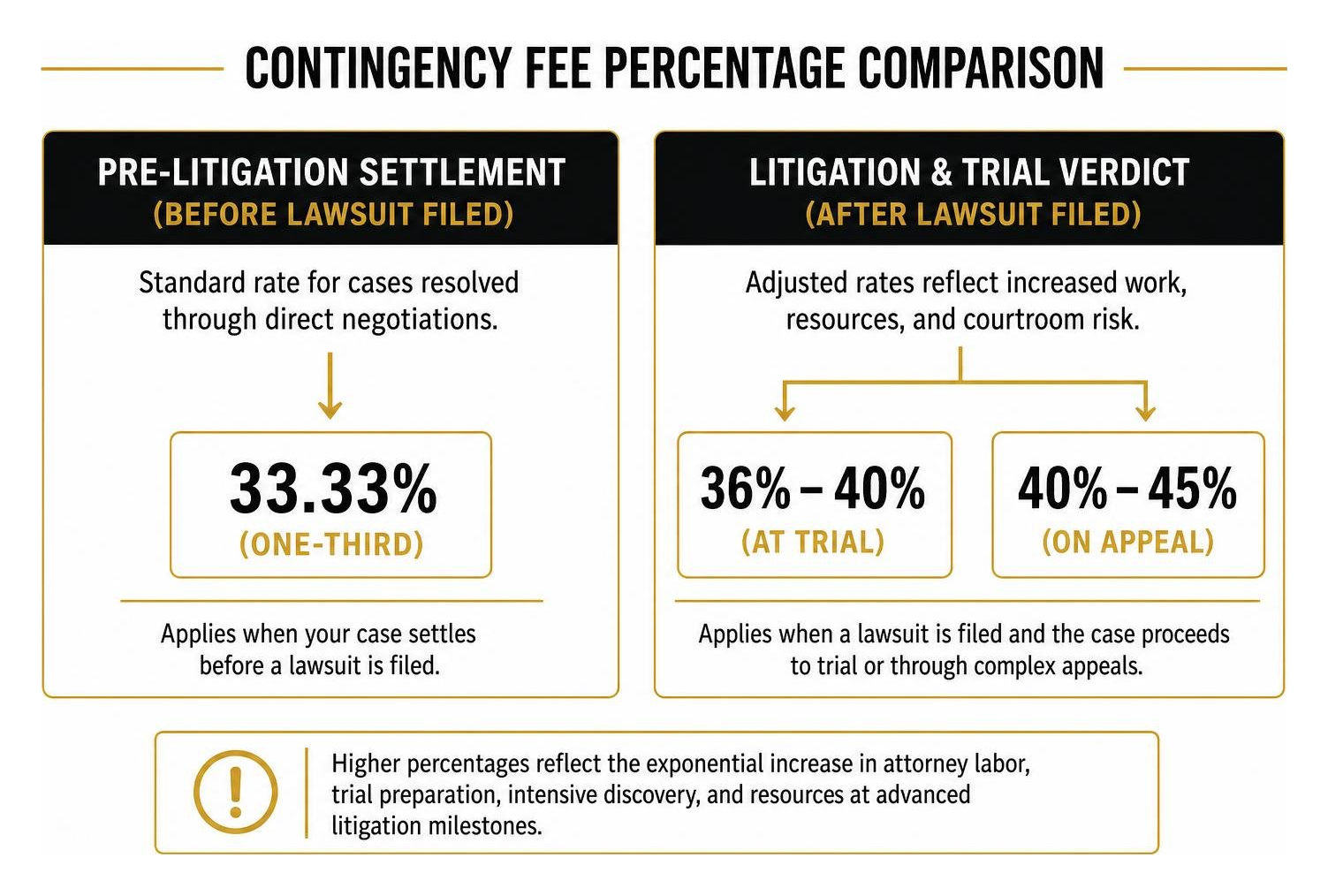
A contingency fee percentage is rarely a one-size-fits-all figure. A one-third (33.33%) contingency fee is standard for cases resolved through direct negotiations before formal litigation or a lawsuit is filed.
However, complex cases requiring substantial litigation often utilize a sliding scale. If an insurer refuses to settle fairly and our team files a lawsuit, the fee structure may adjust to 36%–40% to account for trial preparation, intensive discovery, and courtroom advocacy. In matters that proceed through complex appeals, the rate may reach 40%–45%. This structure reflects the exponential increase in attorney labor, courtroom risk, and resources required at advanced litigation milestones.
Distinguishing Legal Fees from Litigation Case Expenses
One of the most vital distinctions in any fee contract is the difference between legal fees and case expenses. Legal fees pay for the attorney’s time, negotiation skill, and courtroom advocacy. Case expenses—often called disbursements—are out-of-pocket costs required to build and litigate your claim.
Standard litigation expenses include:
- Court filing fees and sheriff service costs ($100 to $500+)
- Official police accident reports, crash reconstruction records, and medical records retrieval
- Deposition transcripts and court reporter fees
- Expert witnesses, such as medical specialists or vocational experts, who frequently charge hourly rates averaging between $450 and $500 per hour
In a transparent contingency contract, your legal team advances these case costs throughout the litigation so you pay nothing out of pocket. Upon a successful recovery, these disbursements are reimbursed from the final settlement. A clear fee agreement will specify that if no recovery is obtained, the client owes zero legal fees.
How to Calculate Your Net Settlement Payout and Deductions
Your gross settlement is the total headline amount agreed upon with the insurance carrier or awarded by a jury. Your net recovery is the actual check delivered into your hands after all legitimate deductions are completed.
Understanding dont let liens ruin your Pennsylvania personal injury settlement is critical to protecting your take-home payout. When evaluating understanding compensation in personal injury cases a deep dive into damages, your final compensation must account for your legal fees, reimbursed litigation expenses, and outstanding healthcare subrogation claims.

Step-by-Step Settlement Math: Gross vs. Net Method
Contingency fee contracts generally calculate fees using either the Gross Method or the Net Method. The chosen method significantly affects your final take-home check.
- Gross Fee Method: The attorney’s percentage is calculated against the total settlement before deducting litigation expenses.
- Net Fee Method: Litigation expenses are subtracted from the total settlement first, and the attorney’s percentage is calculated only on the remaining balance.
Consider a $100,000 settlement with $10,000 in advanced litigation expenses, a $15,000 healthcare lien, and a 33.33% legal fee:
Gross Fee Calculation:
- Gross Settlement: $100,000
- Attorney Fee (33.33% of $100,000): $33,330
- Reimbursed Case Costs: $10,000
- Medical Lien: $15,000
- Client Net Check: $41,670
Net Fee Calculation:
- Gross Settlement: $100,000
- Subtract Case Costs ($10,000): $90,000 Remaining
- Attorney Fee (33.33% of $90,000): $30,000
- Medical Lien: $15,000
- Client Net Check: $45,000
Before distributing any settlement funds, a law firm should provide an itemized, line-by-line settlement breakdown statement so you see every deduction clearly.
Resolving Healthcare Liens and Subrogation Claims
If private health insurance, Medicare, Medicaid, or workers’ compensation covered medical care related to your accident, those entities hold a legal right to reimbursement known as a subrogation lien. Healthcare providers may also hold outstanding medical liens against your claim.
A core value of retaining experienced injury counsel is lien negotiation. Legal counsel directly challenges unjustified line items, applies statutory reduction formulas, and negotiates with lienholders to reduce the total amount owed, maximizing your net take-home recovery.
How to Evaluate and Negotiate a Written Retainer Agreement
Reviewing your retainer agreement ensures total alignment between you and your legal team. Grounded in a comprehensive guide to personal injury law, a formal written contract establishes the scope of representation and guarantees full transparency under state ethics rules.

Key Contract Terms: Personal Injury Lawyer Contingency Fee Explained
When reading your representation agreement, look closely at the following core terms:
- Exact Fee Percentage and Milestones: Verify the base rate and whether the percentage changes if a lawsuit is filed or goes before a jury.
- Handling of Case Expenses: Confirm that the law firm advances all costs and clearly defines what happens to those costs if the case is lost.
- Lien Resolution Responsibilities: Ensure the firm assists in resolving medical and subrogation liens as part of the representation.
- Attorney Liens and Substitution of Counsel: You always retain the right to change attorneys. The agreement should outline that if a prior lawyer is discharged, any fee dispute is resolved between the attorneys without increasing your total percentage fee.
Critical Questions to Ask During Your Free Consultation
Consulting an attorney should be an informative and pressure-free experience. Preparing with resources like personal injury attorney Scranton how to prepare for your first consultation and taking advantage of no cost no stress finding a free personal injury consultation in Scranton Pa helps you evaluate your options.
During your initial case review, ask these essential questions:
- Is your contingency percentage calculated on the gross settlement or net of case expenses?
- Will I owe any out-of-pocket money for advanced case expenses if we do not win?
- Does your percentage increase if a complaint is filed, during trial, or upon an appeal?
- Who will be the primary attorney handling my day-to-day communications and case strategy?
- Do you handle the negotiation and reduction of my medical and insurance liens?
Frequently Asked Questions About Personal Injury Contingency Fees
What happens if my personal injury case is unsuccessful?
Under a standard contingency fee agreement, you owe zero dollars in attorney legal fees if your claim does not recover compensation. Most reputable personal injury firms also waive or absorb all advanced case costs, ensuring that pursuing justice carries no out-of-pocket financial risk.
Can you negotiate the contingency percentage with an attorney?
Yes. While 33% to 40% is standard across civil litigation, fee percentages may be negotiated depending on case complexity, clarity of liability, total damages, and the stage at which the claim resolves. An attorney evaluates these factors during your initial consultation.
Why is my final settlement check smaller than the total award?
Your final check represents your net recovery. Legitimate deductions from the gross settlement include agreed-upon attorney contingency fees, advanced litigation disbursements (court filings, expert fees), and statutory healthcare or subrogation liens paid to medical providers or insurers.
Conclusion
Understanding how contingency fees work gives you the confidence to protect your rights without worrying about upfront legal expenses. By aligning your attorney’s compensation directly with your financial recovery, the contingency fee model ensures that dedicated, experienced legal representation is accessible to everyone.
At Caputo & Mariotti, our team brings over 55 combined years of dedicated legal experience to injury victims across Northeastern Pennsylvania, including Scranton, Moosic, Dickson City, Lackawanna County, Wilkes-Barre, Pittston, Hazleton, and Luzerne County. If you or a family member has suffered an injury, we invite you to explore our personal injury representation and reach out for a free legal consultation to discuss your case today.
