

The dedicated legal team of Caputo & Mariotti
All About the Contributory Negligence Rule in PA Personal Injury
October 29, 2026
Does Contributory Negligence Bar a Pennsylvania Personal Injury Claim?
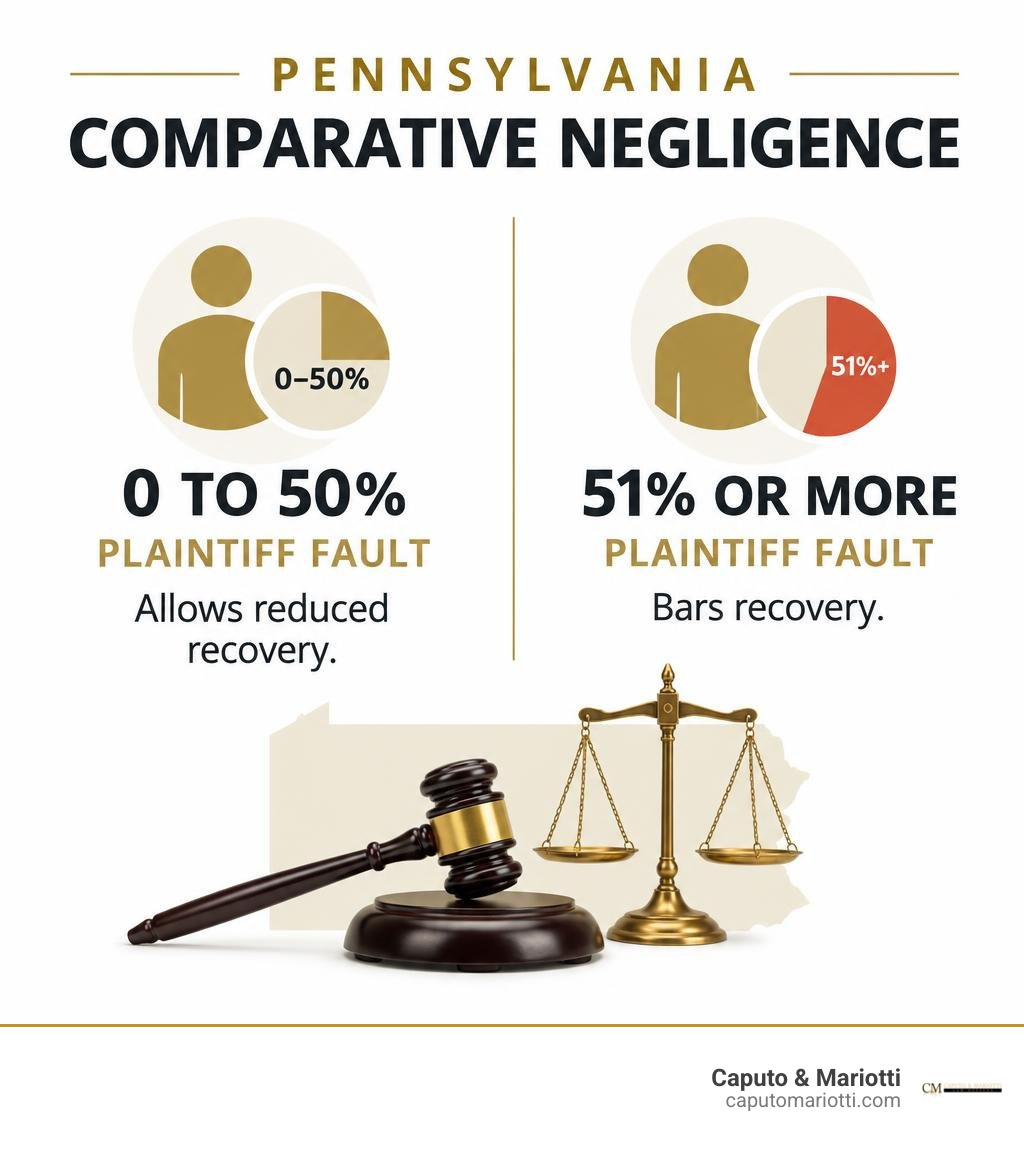
No. Pennsylvania follows modified comparative negligence, not the old rule that barred recovery for any fault. If you are partly responsible for an injury, your damages are reduced by your share of fault. You can still recover if your fault is 50% or less; at 51% or more, you cannot recover. For example, if your damages are $100,000 and you are 30% at fault, your award is reduced to $70,000.
Pennsylvania’s comparative negligence law also affects how payment is divided when more than one defendant caused an injury. This guide explains both rules and what they may mean for your claim.
I am Chris Caputo, a Pennsylvania personal injury attorney with decades of litigation experience. I help clients work through fault questions, including those involving contributory negligence in Pennsylvania personal injury claims.
If you are evaluating your legal options after an accident, learn whether you need a personal injury lawyer in Pennsylvania, review how long a personal injury case takes, or explore the core concepts of personal injury law.
The Modern Framework of Contributory Negligence Pennsylvania Personal Injury Law
Navigating the aftermath of a severe accident requires a firm grasp of how state statutes allocate fault. When individuals explore personal injury law, one of the primary concerns is whether sharing any degree of blame eliminates their right to financial compensation.
Across the United States, jurisdictions handle shared fault using three distinct doctrines: pure contributory negligence, pure comparative fault, and modified comparative negligence. Understanding these distinctions clarifies why Pennsylvania claimants retain vital legal protections even when an accident involves shared missteps.
| Negligence System | How Fault Affects Financial Recovery | Example Outcome ($100,000 Claim) |
|---|---|---|
| Pure Contributory Negligence | Any plaintiff fault (even 1%) completely bars recovery. | 1% at fault = $0 recovery |
| Pure Comparative Fault | Plaintiffs can recover damages reduced by their fault percentage, even if 99% responsible. | 90% at fault = $10,000 recovery |
| Pennsylvania Modified Comparative Negligence | Plaintiffs recover damages reduced by their fault, provided their fault does not exceed 50%. | 30% at fault = $70,000 recovery; 51% at fault = $0 recovery |
Under our Commonwealth’s legal structure, injured victims are protected from the harsh common-law mechanisms of the past, ensuring that financial recovery remains accessible when an injured party is not the primary cause of the harm.
Understanding Fault Thresholds in Contributory Negligence Pennsylvania Personal Injury Claims
Pennsylvania operates under what legal practitioners term the “51 percent bar rule.” Codified under 42 Pa.C.S. § 7102(a), this statutory provision dictates that a plaintiff’s own contributory negligence will not bar recovery if their causal negligence is not greater than the combined causal negligence of the defendants.
When evaluating claims, juries determine the precise percentage of causal negligence attributable to every party involved. If a jury determines that an injured victim bears 20% of the responsibility for an auto collision and the defendant driver bears 80%, the victim’s total financial recovery is diminished by exactly 20%. When assessing total losses—including medical bills, lost wages, and pain and suffering—understanding compensation in personal injury cases allows claimants to project their actual net recovery accurately.
However, if the jury allocates 51% or more of the causal fault to the plaintiff, the statute imposes an absolute bar against recovery, resulting in zero financial compensation.
Historical Shift: Pure Contributory Negligence to Section 7102
Historically, Pennsylvania adhered to pure common-law contributory negligence. Under that outdated doctrine, if an injured party contributed even 1% to the chain of events leading to an injury, insurance carriers could successfully argue for complete dismissal of the lawsuit. This standard frequently produced deeply inequitable outcomes for severely injured individuals facing lifelong medical expenses.
Recognizing these severe consequences, the General Assembly enacted major legislative reforms in 1978, codifying the modern framework found in Section 7102.0 – Title 42 – JUDICIARY AND JUDICIAL PROCEDURE . This shift replaced common-law bars with proportional fault analysis. As of 2026, Section 7102 has been cited in 256 judicial opinions, with 25 citations occurring over the last five years alone, demonstrating its central role in modern Pennsylvania civil litigation.
The Fair Share Act and Multi-Defendant Liability Under 42 Pa.C.S. § 7102

When an injury involves multiple responsible parties—such as a multi-vehicle highway crash on Interstate 81 or a complex construction site incident—the allocation of damages becomes more nuanced. In multi-defendant litigation, the role of evidence in personal injury claims is critical for establishing each tortfeasor’s specific contribution to the harm.
The legislative landscape governing multi-defendant liability underwent substantial evolution leading up to the modern Fair Share Act. In 2002, the legislature passed Act 57 to modify joint and several liability; however, it was invalidated on constitutional single-subject grounds in Deweese v. Weaver, 880 A.2d 54 (Pa. Commonwealth 2005), and formally corrected by the Legislative Reference Bureau in 2007. The General Assembly ultimately reenacted these core multi-defendant reforms in 2011, establishing the statutory structure that controls complex litigation today.
Several Liability vs. Joint and Several Fault at the 60% Threshold
The Fair Share Act fundamentally restructured how plaintiffs collect judgments from multiple co-defendants. Under the current provisions of 42 Pennsylvania Consolidated Statutes § 7102 – Comparative Negligence – Pennsylvania Attorney Resources – Pennsylvania Laws , the default rule is several liability rather than joint liability.
Under several liability, each defendant is responsible only for their exact percentage of causal fault. For example, if Defendant A is found 25% liable and Defendant B is found 75% liable for a $200,000 verdict, Defendant A cannot be forced to pay more than $50,000 (25%).
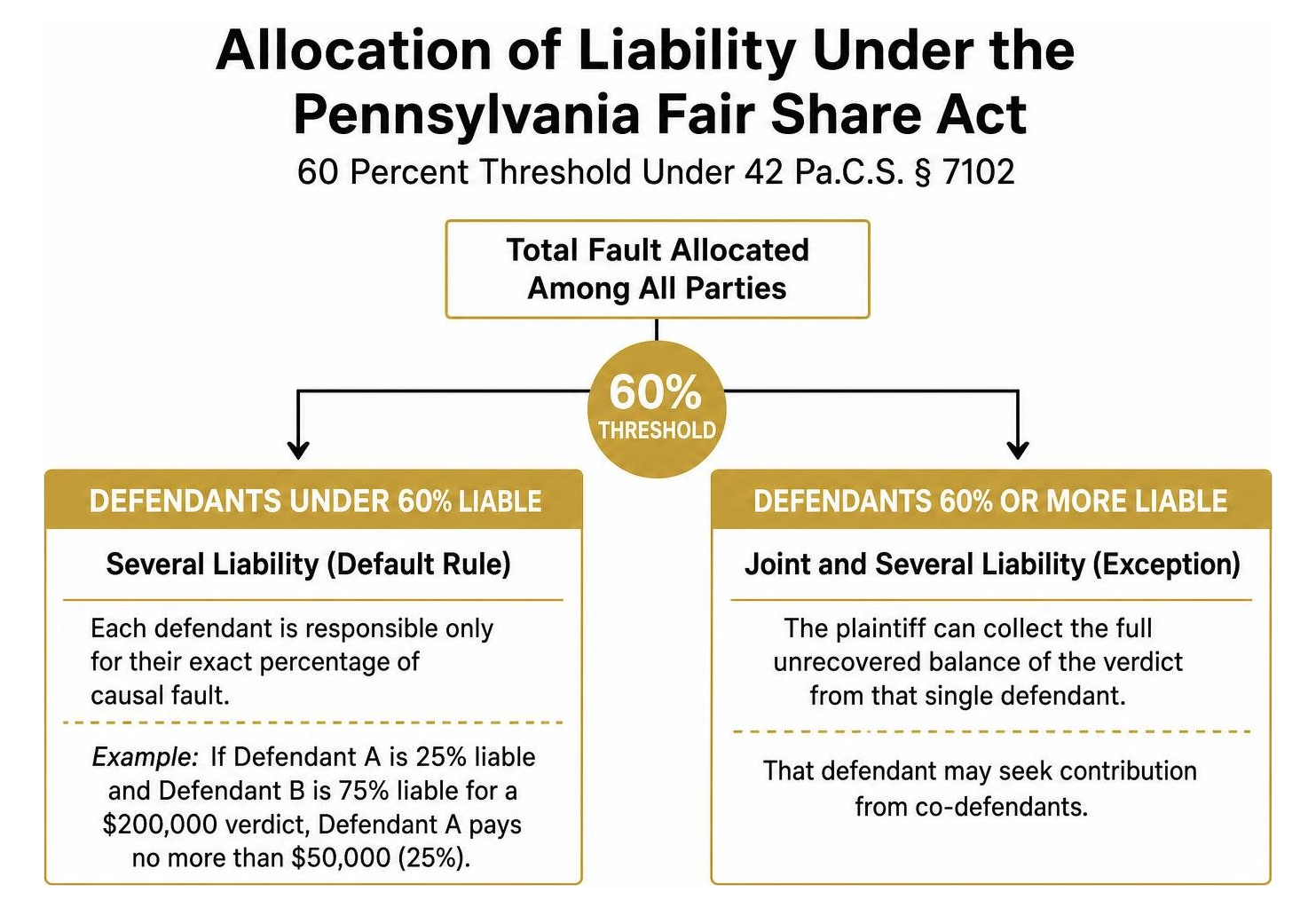
The statute establishes an exception at the 60% threshold:
- Defendants Under 60% Liable: Subject strictly to several liability; they pay only their proportional share.
- Defendants 60% or More Liable: Subject to joint and several liability; the plaintiff can collect the full unrecovered balance of the verdict from that single defendant, leaving that defendant to pursue contribution actions against co-defendants.
Furthermore, joint and several liability automatically applies regardless of fault percentages in specific statutory contexts, including:
- Intentional torts and intentional misrepresentations.
- Violations of the Liquor Code (such as dram shop actions involving visibly intoxicated patrons).
- Civil actions involving the unlawful release of hazardous substances.
How Non-Parties and Settling Defendants Affect Contributory Negligence Pennsylvania Personal Injury Determinations
Under 42 Pa.C.S. § 7102(a.2), the question of fault apportionment extends beyond the parties actively seated at the defense table during trial. Juries are instructed to assess the causal negligence of all entities contributing to the harm, including non-parties and tortfeasors who entered into prior release agreements.
When an injured claimant settles with one joint tortfeasor before trial, that settling party’s percentage of fault is still submitted on the verdict slip. If the settling party is assigned 40% liability by the jury, the remaining non-settling defendants receive a proportional credit matching that 40% allocation, rather than an automatic dollar-for-dollar deduction, depending on the terms of the release.
A complex interaction occurs when an accident happens in the workplace. Under the Pennsylvania Workers’ Compensation Act, employers enjoy absolute tort immunity in exchange for providing no-fault benefits. A dedicated workers’ compensation lawyer understands that while an employer cannot be sued directly in civil court for negligence, establishing third-party liability (such as suing a negligent subcontractor or defective equipment manufacturer) requires careful maneuvering around subsection (a.2) fault allocations.
In workplace injury matters, the Pennsylvania workers’ compensation system operates on a no-fault basis, requiring prompt injury reporting within statutory deadlines (up to 120 days, with maximum protection when reported within 21 days). Injured employees must obtain medical care through employer-designated panel providers during the initial 90 days of treatment. Securing these benefits requires detailed evidence gathering—such as contemporaneous incident documentation, eyewitness statements, diagnostic imaging, and formal claim petition filings through the Bureau of Workers’ Compensation. If a claim is denied, our team manages the legal appeals before Workers’ Compensation Judges and the Appeal Board, all while concurrently evaluating third-party negligence claims under Section 7102.
Protecting Claimant Rights Through the Section 7102(c.2) Savings Provision
When defense counsel attempts to shift blame onto non-parties during litigation, subsection (c.2) provides a vital procedural safeguard for plaintiffs. Known as the statutory savings provision, this rule prevents defendants from escaping liability by pointing fingers at unjoined parties after the traditional two-year personal injury statute of limitations has expired.
Under Section 7102(c.2), if a named defendant files a pleading asserting that a non-party is wholly or partly responsible for the plaintiff’s injuries, the plaintiff is granted an extended window of time (up to 60 days following service of that pleading) to formally join that named entity as a direct defendant. When preparing how to file a personal injury claim in Pennsylvania, leveraging this savings provision ensures that all potentially responsible entities remain subject to financial accountability.
Assumption of Risk Exceptions for Downhill Skiing and Off-Road Vehicles
While modified comparative fault controls the vast majority of common types of personal injury cases, the General Assembly carved out distinct statutory exceptions under Section 7102 for specific high-risk recreational activities. For these activities, the doctrine of voluntary assumption of risk remains a complete bar to civil recovery for inherent risks.
Downhill Skiing and Chepkevich v. Hidden Valley Resort
Under 42 Pa.C.S. § 7102(c), the legislature explicitly recognized that downhill skiing possesses inherent dangers that cannot be entirely eliminated by resort operators without altering the nature of the sport. As a result, ski operators do not owe a legal duty to protect participants from inherent hazards such as changing weather, icy terrain, variations in steepness, or collisions with other skiers.
The landmark Pennsylvania Supreme Court ruling addressing this exception is Chepkevich v. Hidden Valley Resort, L.P., 2 A.3d 1174 (Pa. 2010), a decision citing Section 7102 twenty times. In Chepkevich, the Supreme Court confirmed that the Skier’s Responsibility Act operates as a complete defense when an injury arises from hazards inherent to the sport. While resorts must properly maintain mechanical equipment and refrain from reckless conduct, injuries stemming from ordinary trail hazards cannot be converted into comparative negligence claims.
Off-Road Vehicle Operations and Inherent Activity Risks
Similarly, 42 Pa.C.S. § 7102(b.3) codifies statutory protections for operators of off-road vehicle riding facilities, including all-terrain vehicles (ATVs), trail bikes, and snowmobiles. The statute dictates that voluntary participants accept the known and inherent risks associated with off-road navigation, such as:
- Uneven terrain, sudden elevation drops, and trail ruts.
- Hidden roots, rocks, and surface debris.
- Collisions caused by changing surface traction or vehicle rollovers.
Facility operators are immune from liability for injuries resulting from these inherent environmental conditions. However, liability can still attach if an operator engages in gross negligence, intentionally creates concealed artificial hazards without warnings, or provides defective, improperly maintained rental machinery.
Frequently Asked Questions About Pennsylvania Fault Rules
Can I recover compensation if I am found 50% at fault for an accident in Pennsylvania?
Yes. Under 42 Pa.C.S. § 7102(a), you can recover damages as long as your share of causal negligence is not greater than the combined negligence of the defendants. Being allocated exactly 50% fault allows you to recover 50% of your total awarded damages. The absolute bar only applies if your fault reaches 51% or higher.
What happens if one liable defendant is unable to pay under the Fair Share Act?
Under Pennsylvania’s several liability rules, a defendant assigned less than 60% of the fault cannot be compelled to cover the unpaid portion of an insolvent co-defendant’s share. If a 20% liable defendant cannot pay, that portion is generally uncollectible unless another defendant crossed the 60% threshold, which triggers joint and several liability for the entire award.
How does employer immunity impact personal injury claims involving third parties?
The Pennsylvania Workers’ Compensation Act shields employers from direct personal injury lawsuits through statutory immunity. However, if a third party (such as an equipment manufacturer or property owner) contributed to your work injury, you can pursue a civil claim against that entity. Under Section 7102(a.2), the jury may assess the non-party employer’s actions, but the third-party defendant remains responsible for its own proportional share of the civil damages.
Conclusion
Understanding Pennsylvania’s modified comparative fault rules is essential for protecting your legal rights following an unexpected accident. Rather than assuming that partial fault eliminates your ability to obtain justice, evaluating your claim under 42 Pa.C.S. § 7102 ensures that liability is apportioned accurately.
Key takeaways under Pennsylvania comparative fault include:
- The 51% Bar Rule: Claimants can recover damages as long as their fault does not exceed 50%.
- Proportional Reductions: Financial recoveries are reduced in direct proportion to the plaintiff’s percentage of fault.
- The 60% Fair Share Threshold: Co-defendants are only held jointly and severally liable if their individual fault equals or exceeds 60%.
- Recreational Exceptions: Specific statutory assumptions of risk apply to downhill skiing and off-road vehicle activities.
- Non-Party Allocations: Complex third-party claims require strategic evidence presentation to address settling parties and immune entities.
At Caputo & Mariotti, we bring over 55 years of combined legal experience to personal injury and medical malpractice litigation across Scranton, Wilkes-Barre, Lackawanna County, Luzerne County, and throughout Northeastern Pennsylvania. If you have questions about how fault rules affect your potential recovery, schedule a free case evaluation with our personal injury team to review your options.
