

The dedicated legal team of Caputo & Mariotti
All About Personal Injury Settlement vs Trial in Pennsylvania
October 29, 2026
Personal Injury Settlement vs. Trial in Pennsylvania: Which Path Makes Sense?
A settlement gives you an agreed payment without a trial. A trial asks a judge or jury to decide who is responsible and how much you may recover. When weighing a personal injury settlement vs. trial in Pennsylvania, compare the offer with your losses, the available insurance coverage, and the cost and risk of going to court. You can also consider mediation before trial.
I’m Chris Caputo, and I’ve tried, litigated, and settled hundreds of injury cases since 2007. That experience guides how I explain the decision between resolving an injury claim through negotiation or presenting it in court.
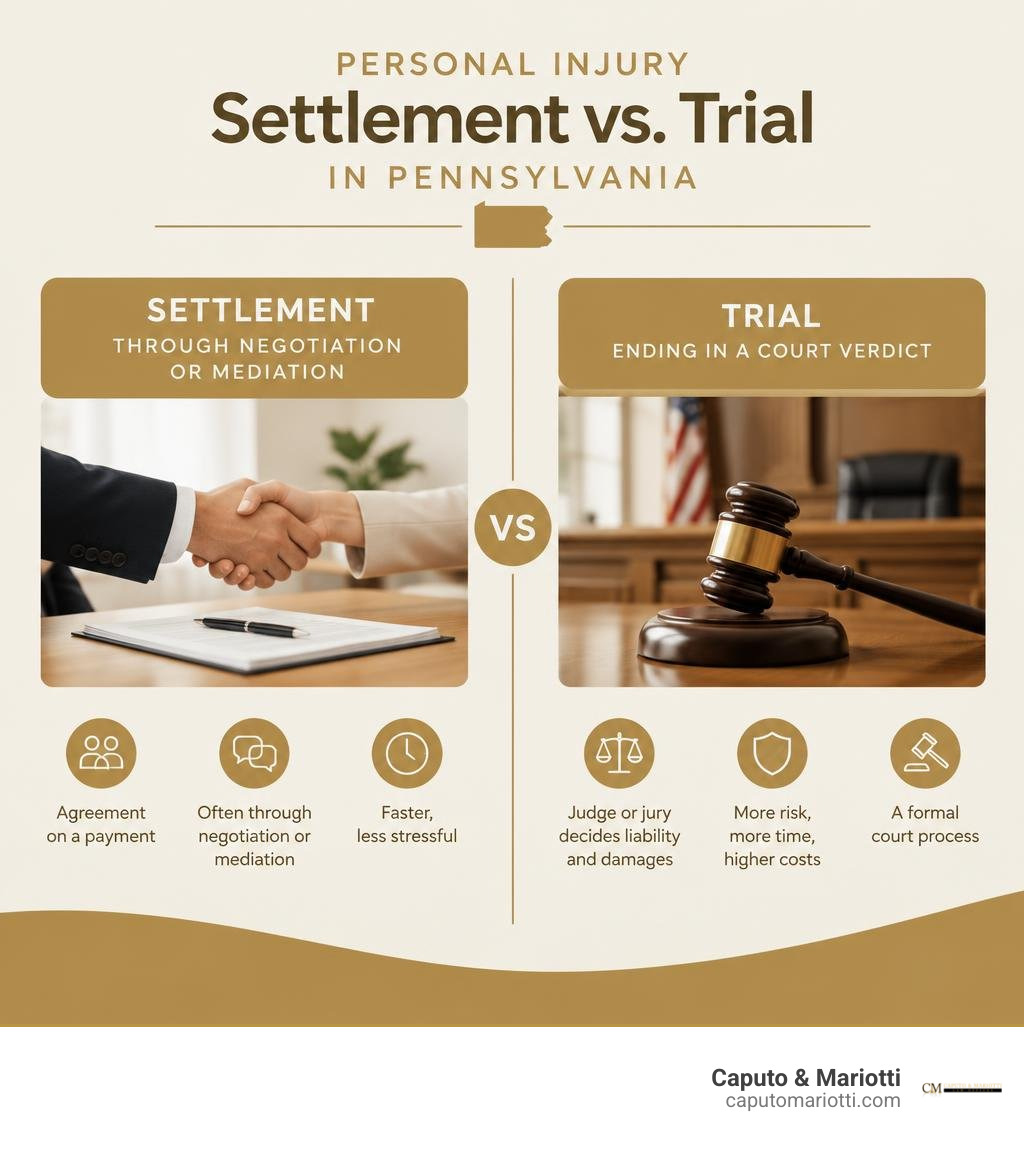
Understanding personal injury law helps you evaluate your legal options. If you are deciding whether you need a personal injury lawyer or considering how long your personal injury case may take, knowing the practical differences between settling and going to trial is essential.
Understanding Personal Injury Settlement vs Trial in Pennsylvania
Every personal injury claim begins with a search for accountability and financial recovery. When an accident occurs in Northeastern Pennsylvania—whether on Interstate 81 in Scranton or near Public Square in Wilkes-Barre—the injured party must navigate complex legal systems to secure compensation. Understanding the step-by-step personal injury legal process is essential to making strategic decisions about your claim.
At its core, civil litigation offers two primary endpoints: an out-of-court settlement negotiated between the parties or a formal trial verdict delivered by a judge or jury. While both paths aim to resolve damages arising from negligence, their execution, timeline, risk profiles, and finality differ substantially under Pennsylvania law.
Defining Out-of-Court Settlements
An out-of-court settlement is a binding contract between the injured plaintiff and the defendant or their insurance carrier. In exchange for an agreed-upon financial payout, the plaintiff signs a comprehensive release of liability. This release permanently closes the legal claim, preventing any future lawsuits arising from the same incident.
Settlements can occur at any stage of a dispute:
- Pre-Litigation: Before a formal complaint is filed in the Court of Common Pleas.
- During Discovery: After depositions, medical record exchanges, and expert reports reveal the strengths of the case.
- Alternative Dispute Resolution: During mediation or non-binding arbitration sessions.
- Mid-Trial: Even while a jury deliberates in the courtroom.
The primary benefit of settling is predictability. Insurers utilize specialized software and historical data to value claims; understanding how insurance companies calculate injury settlements helps plaintiffs evaluate whether an offer realistically reflects their damages or represents a quick attempt to minimize corporate payouts.
Defining the Civil Trial Process
A civil trial is a formal proceeding where disputed facts, liability determinations, and damage evaluations are presented to an impartial fact-finder—either a jury or a judge during a bench trial. In Pennsylvania, personal injury lawsuits are primarily tried in county Courts of Common Pleas, such as Lackawanna County or Luzerne County.
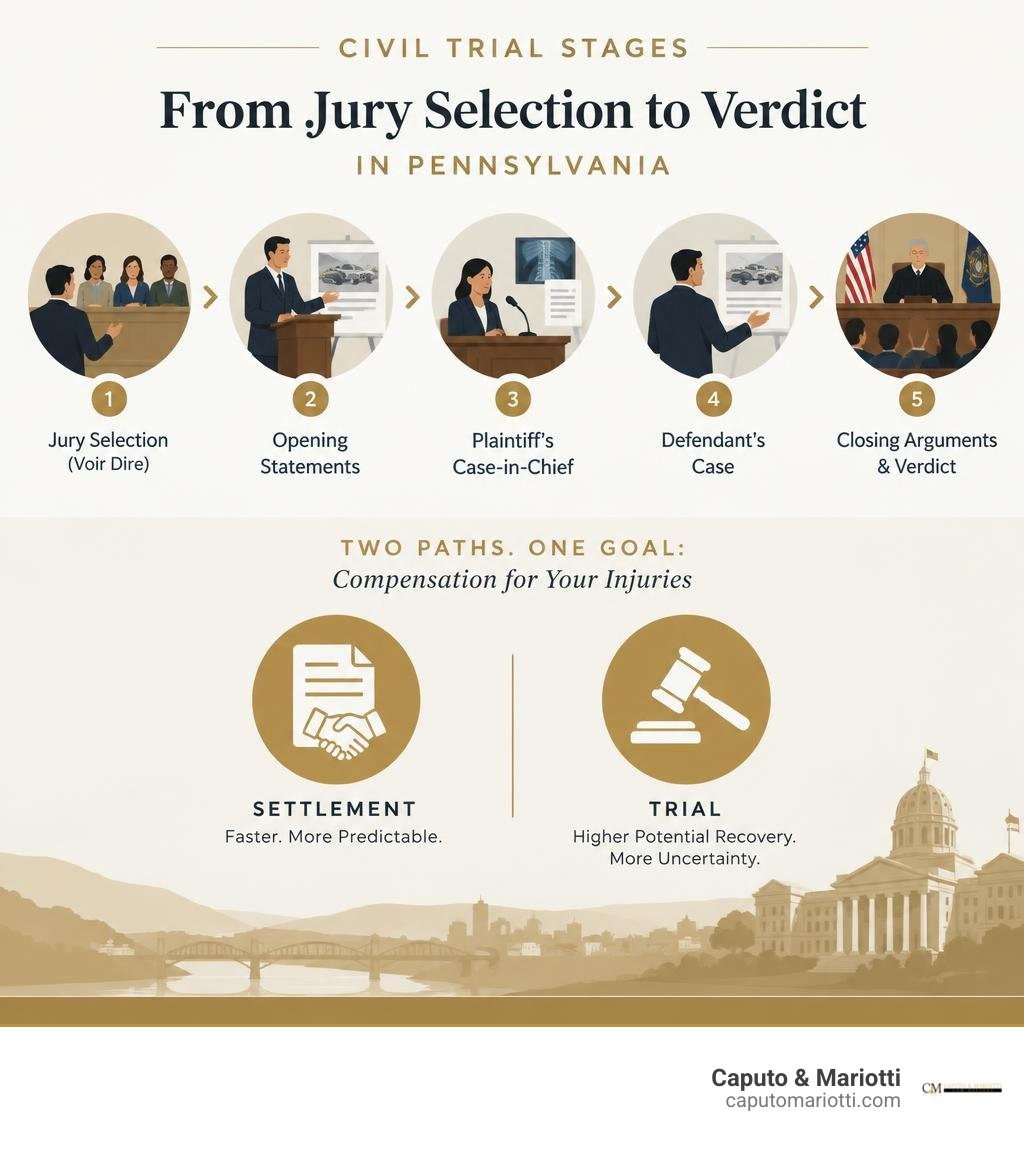
The trial process follows strict procedural stages:
- Jury Selection (Voir Dire): Questioning prospective jurors to seat an unbiased panel.
- Opening Statements: Outlining what the evidence will demonstrate.
- Plaintiff’s Case-in-Chief: Presenting medical records, testimony, accident reconstruction experts, and economic loss calculations.
- Defendant’s Case: Challenging fault, pre-existing medical conditions, and damage totals.
- Closing Arguments and Jury Instructions: Summarizing legal arguments before the jury deliberates on liability and damages.
Successfully navigating personal injury trials from evidence to appeals requires extensive preparation, rigorous trial advocacy, and complete familiarity with Pennsylvania rules of evidence and civil procedure.
Comparing Outcomes: Costs, Timelines, and Recovery
Deciding whether to accept a settlement or take your case to a courtroom verdict involves weighing financial security against the potential for higher compensation.

| Factor | Out-of-Court Settlement | Civil Trial Verdict |
|---|---|---|
| Speed of Resolution | Faster (often months to a year) | Slower (typically 18 months to several years) |
| Litigation Expenses | Lower (limited court and expert witness costs) | Higher (extensive expert fees, deposition transcripts, exhibits) |
| Public Record | Confidential terms available | Public courtroom proceedings and public record |
| Payout Predictability | Guaranteed agreed amount | Uncertain (verdict can be high, low, or zero) |
| Appellate Risk | None; settlement is final and non-appealable | High; verdicts can be appealed, delaying payouts |
Strategic Considerations in Personal Injury Settlement vs Trial in Pennsylvania
A negotiated settlement provides financial certainty and eliminates the risk of an unfavorable verdict. When you agree to a settlement, you eliminate the possibility that a jury might misinterpret the evidence, assign disproportionate comparative fault, or return an inadequate award.
Conversely, taking a case to trial is often necessary when an insurer acts unreasonably, disputes clear liability, or refuses to pay fair value for catastrophic injuries. Trials hold wrongdoers publicly accountable and can yield awards that fully reflect severe physical impairment and emotional distress. Leveraging proven strategies to maximize injury compensation enables our team to negotiate from a position of strength, ensuring that insurance adjusters understand we are prepared to try the case if their offers remain insufficient.
Timeline and Financial Impact of Each Path
Time is a critical consideration for injured individuals facing mounting medical bills and lost wages. Understanding how long a personal injury case takes in Pennsylvania helps manage expectations. Pre-suit settlements may conclude within several months once maximum medical improvement is documented. In contrast, taking a lawsuit through discovery, pre-trial motions, court scheduling backlogs, and trial proceedings often takes two years or more.
Litigation costs also escalate as trial approaches. Retaining medical experts, orthopedic surgeons, life-care planners, and accident reconstructionists requires significant financial investment. If a case resolves via settlement early, these expenses remain lower, preserving a larger portion of the gross recovery for the client.
Critical Pennsylvania Legal Factors Influencing Your Choice
Pennsylvania has specific statutory frameworks that directly shape settlement valuations and courtroom risks.

Pennsylvania No-Fault Insurance and Tort Thresholds
Pennsylvania operates a hybrid auto insurance framework combining no-fault medical coverage with traditional tort liability. Under the Motor Vehicle Financial Responsibility Law (MVFRL), your own auto insurance policy covers initial medical expenses and wage losses through First-Party Medical Benefits, regardless of who caused the collision.
When seeking recovery for non-economic damages, such as pain and suffering, your auto insurance policy election becomes critical:
- Full Tort: Allows you to seek compensation for all economic and non-economic damages, regardless of injury severity.
- Limited Tort: Restricts your ability to sue for pain and suffering unless your injuries meet the statutory definition of a “serious impairment of a body function” or qualify under specific exceptions.
Evaluating how these thresholds impact recoverable damages in a PA personal injury case is central to determining whether an insurer’s settlement offer is reasonable or if a trial is required to prove a serious impairment.
Workplace injuries follow distinct statutory guidelines. If you are injured on the job in Lackawanna or Luzerne County, our experienced workers’ compensation lawyer team handles the no-fault administrative claims process. In Pennsylvania, workers’ compensation covers medical treatment and wage replacement without requiring proof of employer negligence. You must report workplace injuries within statutory deadlines—typically 21 to 120 days—gather supporting witness testimony and medical records, and navigate formal filing procedures and legal appeals before Workers’ Compensation Judges if benefits are denied.
Policy Limits, Underinsured Motorist Coverage, and Arbitration
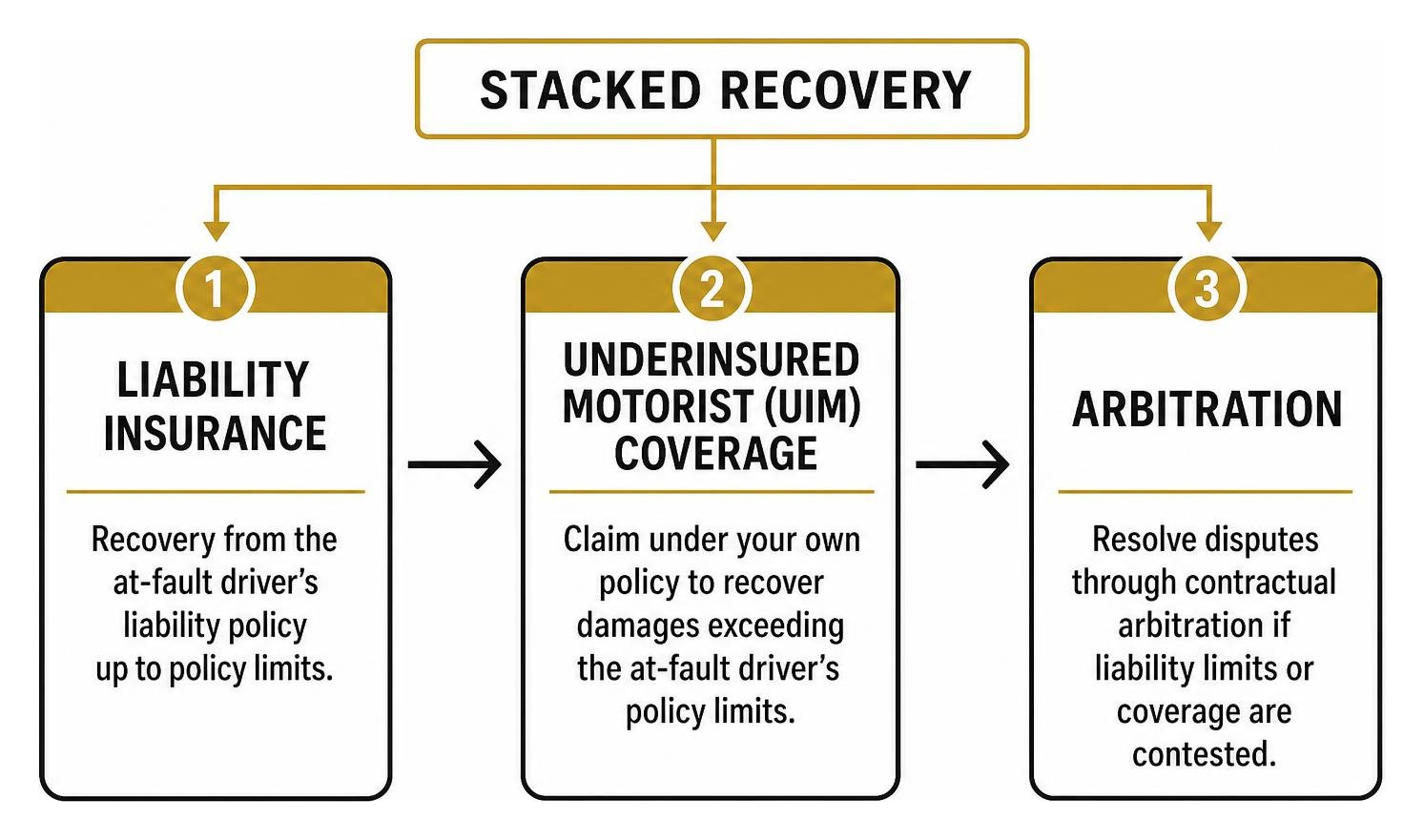
In Pennsylvania, the mandatory minimum liability insurance coverage for bodily injury is only $15,000 per person and $30,000 per accident. If a defendant carrying state minimum insurance causes severe injuries resulting in $100,000 in damages, their insurer will generally offer the $15,000 policy limit to settle the claim.
When liability policy limits are insufficient, injured plaintiffs must evaluate supplemental avenues:
- Underinsured Motorist (UIM) Coverage: Filing a claim under your own auto policy to cover remaining damages above the at-fault driver’s policy limits.
- Arbitration: Resolving disputes through contractual arbitration proceedings rather than full jury litigation, as discussed in FreeAdvice legal analysis on liability limits and arbitration.
Pennsylvania Two-Year Statute of Limitations
Under Title 42 Pa.C.S. § 5524, the statute of limitations for personal injury actions in Pennsylvania is strictly two years from the date of the injury. If you fail to settle your claim or file a formal lawsuit in the appropriate Court of Common Pleas before this deadline passes, you lose your legal right to seek compensation forever. Preserving settlement leverage requires proactive investigation and timely filing well before this statutory window closes.
Alternative Dispute Resolution: Mediation and Arbitration in PA
Not every injury case exists as a binary choice between an informal settlement and a multi-day jury trial. Alternative Dispute Resolution (ADR) offers structured middle-ground options.
Navigating Personal Injury Settlement vs Trial Pennsylvania Pathways
Mediation is a voluntary, confidential process where parties present their arguments to a neutral third-party mediator—frequently a retired judge or respected trial attorney. The mediator does not issue a binding ruling; instead, they facilitate negotiations, evaluate evidentiary weaknesses, and assist the parties in finding a compromise.
Engaging in mediation allows plaintiffs to test their arguments before taking on courtroom expenses. When assessing initial offers, evaluating whether you should accept a settlement offer requires balancing the certainty of an agreed compromise against the risks of courtroom litigation.
Arbitration, by contrast, involves submitting the dispute to an arbitrator or panel of arbitrators who hear evidence and render an award. Arbitration can be binding (final and enforceable) or non-binding (allowing either party to appeal or proceed to trial).
What to Do If an Insurance Settlement Offer Is Insufficient
Insurance companies often present initial settlement offers that undervalue long-term medical needs, permanent impairment, and non-economic suffering. When an insurer refuses to negotiate in good faith, your primary leverage is thorough trial preparation.
When an offer is inadequate:
- Do not sign releases or accept fast checks without legal review.
- Work with your medical providers to ensure all future treatment needs and functional limitations are documented.
- Calculate total economic damages, including wage loss and diminished earning capacity.
- Enlist dedicated Pennsylvania personal injury counsel to file a formal complaint, conduct discovery, and prepare the case for trial.
Insuring carriers closely evaluate whether opposing counsel regularly tries cases. Demonstrating courtroom readiness frequently motivates adjusters to improve their settlement offers before jury selection begins.
Frequently Asked Questions About Settlements and Trials in Pennsylvania
What percentage of personal injury cases settle before trial in Pennsylvania?
Across Pennsylvania and national civil courts, approximately 90% to 95% of personal injury cases settle before reaching a trial verdict. Cases frequently resolve through pre-litigation negotiations, post-discovery settlement conferences, or formal mediation.
Can a Pennsylvania personal injury case settle after a trial has already started?
Yes. Settlement discussions can continue throughout the trial. Parties frequently settle after opening statements, following crucial witness testimony, or while the jury deliberates. Parties may also enter into “high-low agreements,” establishing guaranteed minimum and maximum payout parameters regardless of the jury’s final verdict.
How does Pennsylvania’s modified comparative negligence law affect my case at trial?
Under Pennsylvania’s comparative negligence statute (42 Pa.C.S. § 7102), recovery is governed by a 51 percent comparative fault rule. An injured plaintiff can recover damages as long as their share of causal negligence is 50 percent or less. However, their total compensation is reduced by their percentage of fault. If a plaintiff is found to be 51 percent or more at fault, they are legally barred from recovering any damages at trial.
Conclusion
Choosing between accepting a settlement offer and proceeding to trial is one of the most critical decisions in your personal injury case. A settlement guarantees financial certainty, eliminates litigation costs, and brings timely closure. A trial offers the opportunity for full public accountability and the potential for a larger financial recovery when an insurer refuses to make a fair offer.
At Caputo & Mariotti, we bring over 55 years of combined legal experience to personal injury and medical malpractice claims across Northeastern Pennsylvania, including Scranton, Wilkes-Barre, Hazleton, Pittston, Moosic, and Dickson City. We prepare every claim with the meticulous detail required for the courtroom, giving our clients the strongest possible position during negotiations while standing ready to advocate before a jury.
If you or a loved one has suffered an injury, contact us today to schedule a free legal consultation and discuss the best legal strategy for your claim.
