

The dedicated legal team of Caputo & Mariotti
Pennsylvania Workers’ Comp Statute of Limitations Explained
October 29, 2026
Pennsylvania Workers’ Comp Filing Deadlines at a Glance
In Pennsylvania, you generally have three years from a work injury to file a workers’ compensation claim petition. Tell your employer as soon as possible: waiting more than 21 days can cost you benefits for the days before you gave notice, and waiting more than 120 days can bar your claim. Occupational diseases and claims involving benefits already paid have different timing rules.
These deadlines answer different questions: when you must report the injury and when you must file a petition. Knowing both can help you protect your rights under the Pennsylvania workers’ comp statute of limitations.
I’m Chris Caputo, a Pennsylvania injury attorney with decades of litigation experience, including disputes over denied insurance claims. This guide will help you identify the dates that matter most to your claim.

Related workers’ compensation guides:
- How to File a Workers Comp Claim Pennsylvania
- Workers Comp Denied Claim Pennsylvania
- Can I Be Fired While on Workers Comp Pennsylvania
Key Deadlines Under the Workers Comp Statute of Limitations Pennsylvania
Pennsylvania operates a mandatory no-fault workers’ compensation system designed to provide medical treatment and wage-loss compensation without requiring you to prove employer negligence. However, this safety net is governed by strict statutory timelines. Missing a filing milestone can permanently extinguish your legal right to recover benefits.
Under Section 315 of the Pennsylvania Workers’ Compensation Act, the primary statute of limitations requires that an employee file a formal Claim Petition within three years from the date of injury. If your employer or their insurance carrier made wage-loss payments in lieu of workers’ compensation, that three-year clock begins on the date of the most recent compensation check. When handling complex disputes, working with a seasoned workers’ compensation lawyer ensures you meet every procedural threshold and preserve your wage-loss rights.
Understanding the sequence of steps makes navigating workers compensation claims significantly more manageable. The legal process balances employer notice deadlines with formal administrative court filings.
| Action Required | Governing Statute | Legal Deadline | Consequence of Missing Deadline |
|---|---|---|---|
| Initial Notice to Employer | Section 311 | Within 21 days of injury | Wage loss paid only from notice date forward |
| Final Notice to Employer | Section 311 | Within 120 days of injury | Complete forfeiture and legal bar of all benefits |
| Claim Petition Filing | Section 315 | Within 3 years of injury or last payment | Complete statutory bar against future claims |
| Petition to Reinstate (Terminated) | Section 413 | Within 3 years of last benefit check | Permanent loss of disability reinstatement rights |
| Petition to Reinstate (Suspended) | Section 413 | Within 500 weeks of suspension date | Inability to resume wage loss after return to work |
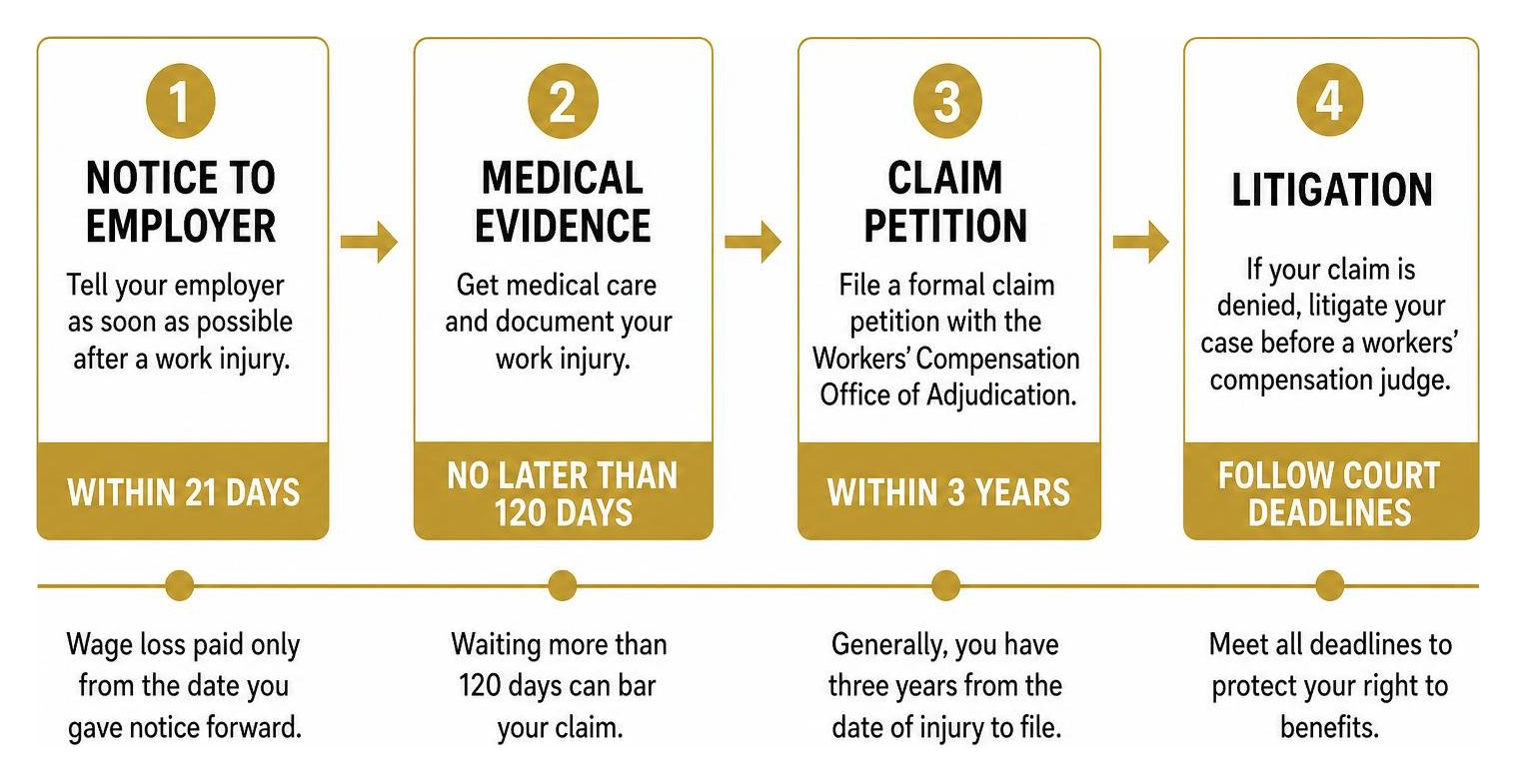
Reporting Your Workplace Injury: The 21-Day and 120-Day Rules
Before Section 315 even comes into play, an injured employee must satisfy the strict notice requirements codified in Section 311 of the Act. Learning what to do if injured at work immediately after an incident occurs is essential to keeping your claim viable.
- The 21-Day Window: If you report your injury to a direct supervisor, human resources department, or employer representative within 21 days of the incident, wage-loss benefits are retroactive to your first day of missing work (subject to the standard 7-day waiting period, which is reimbursed once disability extends past 14 days).
- The 120-Day Absolute Bar: If notice is given after 21 days but within 120 days of the injury, benefits are payable only starting from the exact date notice was given. If you fail to notify your employer within 120 days, Pennsylvania law establishes an absolute statutory bar against your claim, regardless of how severe your injuries are.
Seeking Medical Treatment Under Pennsylvania Law
Securing prompt medical treatment is critical for your physical recovery and legal claim. Under the Pennsylvania Workers’ Compensation Act, if your employer maintains a properly posted list of at least six designated healthcare providers (a panel list), you must treat with a panel provider for the first 90 days following your initial visit. If the employer fails to post the list properly or provide written acknowledgment forms, you are free to seek treatment with your own physician immediately. After 90 days, you may switch to any doctor of your choosing, provided you give your employer notice within five days of the change.
Gathering Essential Evidence and Documentation
Building a successful workers’ compensation claim requires robust evidence gathering from day one. Crucial documentation includes:
- Incident and Incident Reports: Written copies of the injury report submitted to the employer.
- Medical Records and Diagnostic Scans: Physician notes, MRI reports, operative logs, and physical therapy records detailing the exact diagnosis and work-related causation.
- Eyewitness Testimony: Written statements or contact details of coworkers who witnessed the accident or can testify to workplace conditions.
- Wage Records: Pay stubs and tax records used to calculate the average weekly wage (AWW) accurately.
The Workers’ Compensation Filing Process
If your employer’s insurance carrier issues a Notice of Workers’ Compensation Denial or fails to accept the full scope of your injury, you must initiate the formal administrative filing process. You do this by filing a formal Claim Petition (Form LIBC-362) with the Pennsylvania Bureau of Workers’ Compensation within the three-year statute of limitations. The petition is assigned to a Workers’ Compensation Judge (WCJ) in your county, who conducts evidentiary hearings, hears witness and medical expert testimony, and issues a binding decision. If either party disputes the WCJ decision, legal appeals may be filed with the Workers’ Compensation Appeal Board (WCAB) and the Commonwealth Court of Pennsylvania.
Traumatic Work Injuries vs. Cumulative Trauma
Determining when the clock starts running depends entirely on whether your condition stems from an acute workplace accident or repetitive wear-and-tear. Traumatic accidents—such as falls, machinery malfunctions, or motor vehicle crashes—have an obvious date of injury. The three-year statute of limitations begins on the exact calendar day the incident occurred.
Recognizing serious workplace injury signs early is critical when repetitive motion is involved. For cumulative trauma conditions like carpal tunnel syndrome, herniated spinal discs from heavy lifting, or chronic joint degeneration, the legal date of injury is generally established as the date the condition progressed to the point where it caused a loss of earning power, or the date a medical provider specifically advised you that the condition was caused by your work duties.
Occupational Illnesses, Latent Conditions, and the Discovery Rule

Workplace illnesses that develop slowly over years of hazardous exposure do not fit neatly into traumatic injury timelines. Conditions like silicosis, occupational asthma, chemical toxicity, and asbestos-induced lung disease develop over extended periods.
To protect employees facing these hidden harms, Pennsylvania courts apply the “creeping disease doctrine” and the common-law discovery rule. Under the landmark decision in Trieschock v. Owens Corning Fiberglas Co., the limitations period for an insidious disease does not automatically start upon initial workplace exposure or even upon a tentative, uncertain diagnosis. Instead, the statute begins to run only when the injured individual knows, or through reasonable diligence should know:
- That they have sustained a physical injury or illness, and
- That the injury or illness was caused by the conduct or environment of another party.
The standard of reasonable diligence requires that an individual actively investigate persistent medical issues. In Baumgart v. Keene Building Products Corp., the Supreme Court of Pennsylvania clarified that the discovery rule will not toll the statute of limitations if the medical condition and its workplace causation were reasonably ascertainable within the statutory window through standard medical evaluations and inquiries.
How the Workers Comp Statute of Limitations Pennsylvania Applies to Occupational Diseases
Special statutory rules govern navigating occupational disease claims under Section 301(c)(2) of the Act. To be legally compensable, disability or death resulting from an occupational disease must occur within 300 weeks after the employee’s last date of employment in an occupation involving direct exposure to the hazard.
Once disability or diagnosis occurs within that 300-week window, the claimant must provide notice to the employer within 120 days and file a formal Claim Petition within three years from the date disability began and its work-related nature became known.
Statutory Rebuttable Presumptions for Workplace Illnesses
Section 108 of the Pennsylvania Workers’ Compensation Act designates specific medical conditions as scheduled occupational diseases. Under Section 301(e), if an employee worked in an industry where that particular condition is recognized as an occupational hazard, the law creates a rebuttable presumption that the disease arose out of and in the course of employment.
In Jeannette District Memorial Hospital v. WCAB, the Commonwealth Court established that healthcare professionals exposed to bodily fluids who contract hepatitis C receive the benefit of this statutory presumption without being required to prove a specific needle stick or exposure date. The burden shifts directly to the employer to produce substantial, competent medical evidence establishing an alternative, non-occupational cause. Employers must also raise procedural defenses like timely notice promptly; failing to do so waives those objections on appeal.
Benefit Modifications, Suspensions, and NCP Amendments
When an employer initially accepts a work injury, they issue a Notice of Compensation Payable (NCP). However, initial NCPs often list only a narrow injury description, such as a “lumbar strain,” while overlooking accompanying disc herniations or nerve damage.
Under Section 413 of the Act, an injured employee can file a Review Petition to expand the official injury description. Understanding the role of medical evaluations in claim reviews is critical during this process. In Pennsylvania, a Review Petition to add injuries that existed at the time the original NCP was issued must be filed within three years from the date of injury if no disability compensation was paid, or within three years from the date of the most recent compensation check.
Key triggers and timelines for workers’ compensation petitions include:
- Claim Petition (Denied Claim): Must be filed within 3 years of the injury date.
- Review Petition (Amending NCP): Must be filed within 3 years of the injury date or the last indemnity payment.
- Reinstatement Petition (After Termination): Must be filed within 3 years of the final benefit check.
- Reinstatement Petition (After Suspension): Must be filed within 500 weeks from the suspension date.
- Fatal Claim Petition (Death Benefits): Must be filed within 3 years of the date of death resulting from the work injury.
Reinstating Benefits Under the Pennsylvania Workers’ Comp Statute of Limitations
The rules for reinstating wage-loss benefits differ substantially depending on whether your benefits were legally terminated or merely suspended:
- Terminated Benefits: If a Workers’ Compensation Judge (WCJ) issued an order terminating your benefits—finding you fully recovered—you have exactly three years from the date of your last compensation payment to file a Reinstatement Petition. You must prove your disability has recurred or increased.
- Suspended Benefits: If your wage-loss benefits were suspended because you returned to work with no wage loss (even while remaining physically impaired), you have up to 500 weeks from the effective date of the suspension to petition for reinstatement if your earning power drops again due to the injury. Reviewing our guide on workers comp duration in Pennsylvania provides further insight into managing these extended timelines.
Specific Loss Awards and Fatal Claim Petitions
Pennsylvania provides separate statutory compensation for the permanent loss, or loss of use, of specific body parts (such as fingers, limbs, eyesight, or hearing), as well as serious facial disfigurement. A claim for specific loss benefits must be brought within three years of the date the loss became permanent and total for all practical intents and purposes.
In tragic cases involving fatal workplace injuries or occupational illnesses, surviving dependents must file a Fatal Claim Petition under Section 315 within three years from the date of the worker’s death. Furthermore, the death must have occurred within 300 weeks of the original injury to remain compensable under the Act.
Exceptions, Tolling Provisions, and Interstate Claims

While statutory deadlines are strictly enforced, certain circumstances can toll (pause) the clock or prevent an employer from asserting a statute of limitations defense. Under the doctrine of equitable estoppel, if an employer or insurance adjuster misleads an injured worker into believing their claim has been officially accepted or that paperwork was filed on their behalf, the court may bar the employer from raising a timeliness defense.
Interstate benefit payments also impact Pennsylvania deadlines. In Martin v. WCAB, the Commonwealth Court ruled that when an employee injured in Pennsylvania receives voluntary workers’ compensation payments under the laws of another state, those payments constitute compensation that tolls Pennsylvania’s three-year statute of limitations under Section 315. The limitations period does not begin running until the date of the most recent out-of-state payment.
If your benefits are withheld or contested, understanding the procedures for handling denied workers comp claims will protect you from running out of time during administrative appeals.
Frequently Asked Questions About Pennsylvania Workers’ Comp Deadlines
What happens if I miss the 120-day notice deadline in Pennsylvania?
Missing the 120-day notice deadline under Section 311 creates an absolute legal bar to receiving workers’ compensation benefits in Pennsylvania. Unless you can prove employer fraud, intentional deception, or that your condition is an occupational disease where you did not yet know the diagnosis was work-related, the Workers’ Compensation Judge has no legal authority to award wage-loss or medical benefits.
Does receiving medical-only payments extend the 3-year statute of limitations to file a claim petition?
No. Pennsylvania courts have repeatedly held that the payment of medical bills by an employer or insurer does not constitute “compensation” for purposes of tolling the three-year statute of limitations under Section 315. If your employer pays your medical bills under a Medical-Only Notice of Compensation Payable but denies wage loss, you must still file a formal Claim Petition within three years of the accident date if you require wage-loss benefits.
How long do I have to file a petition if my workers’ comp claim is denied?
If your employer’s insurance carrier issues a Notice of Workers’ Compensation Denial (Form LIBC-496), you have three years from the exact date of injury to file a formal Claim Petition with the Bureau of Workers’ Compensation. For actionable insights on overcoming an insurance dispute, read our denied claim legal strategies.
Conclusion
The Pennsylvania Workers’ Compensation Act provides crucial financial and medical security for injured employees, but its procedural deadlines are unforgiving. From reporting an injury within 21 days to filing formal petitions within three years or managing 500-week suspension windows, keeping track of these timelines is vital to protecting your rights.
Caputo & Mariotti represents injured workers and their families throughout Scranton, Wilkes-Barre, Lackawanna County, Luzerne County, Hazleton, Dickson City, Moosic, Pittston, and across Northeastern Pennsylvania. With combined experience of over 55 years, our dedicated legal team is committed to securing the full wage loss and medical benefits you deserve. If you suffered a workplace injury or contracted an occupational illness, do not wait until statutory deadlines approach—schedule a workers’ compensation legal consultation with us today to safeguard your claim.